
Reviewed · JEWISH QUARTER TOURS
Jewish Heritage in Hungary with a Historian
Budapest’s Jewish Quarter is not just a collection of grand synagogues. It is a place where medieval markets, wartime rescue efforts, Orthodox traditions, ruin bars, and today’s café culture all meet. This walking tour connects those pieces with a historian guide, then finishes with flódni, a layered Jewish-Hungarian pastry.
I like the small group of up to 10 because it gives you room to ask direct questions. I also like the way the route looks beyond the Holocaust, covering centuries of Jewish life while still dealing honestly with the darkest years. Guides named Andrea, Gabor, Barbi, Noémi, and András have led this experience, and the strongest praise centers on their clear, patient explanations.
The main limitation is simple: you do not go inside the Great Synagogue, and admission to the Kazinczy Street and Great Synagogues is not included. If you want a full interior visit, you will need to plan that separately.
Key points to know before you book
- A historian-led walk through Jewish Budapest: The tour links Jewish life, politics, architecture, rescue work, and modern city culture.
- Small groups make the history personal: With no more than 10 people, you can ask questions and follow up on subjects that interest you.
- Three important synagogues appear on the route: You pass Rumbach Street, Kazinczy Street, and Dohány Street, with the most time given to the latter two.
- Raoul Wallenberg gets a proper place in the story: His statue becomes a starting point for discussing the diplomat’s efforts to save Jewish lives.
- Szimpla Kert adds modern Budapest to the picture: The first ruin bar shows how the old Jewish Quarter changed into one of the city’s best-known nightlife districts.
- Flódni is part of the price: At Solinfo Café, you try this traditional Jewish-Hungarian cake rather than ending with history alone.
Why this Jewish Budapest walk is more than a synagogue tour
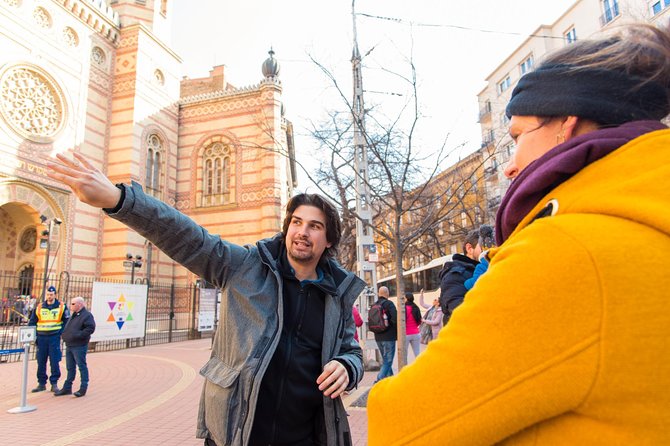
This experience works best if you want context. You are not simply led from one ornate building to another. The route asks how Jewish communities shaped Budapest, how they survived political upheaval, and how the old Jewish Quarter became a center for cafés, bars, and nightlife.
The advertised focus reaches back roughly 800 years, while the route itself gives particular attention to the period from the seventeenth century to today. That range matters. Jewish life in Hungary cannot be understood through the events of the 1940s alone, even though the Holocaust and its aftermath are essential parts of the story.
I would expect the guide to adjust the emphasis to the group. Gabor, for example, has been praised for giving an honest account of both the good and bad parts of Hungary’s past. Other guides, including Andrea, Barbi, Noémi, and András, have been described as warm, patient, and willing to answer questions. The exact guide is not fixed in the information provided, but the format clearly depends on a guide who can handle serious subjects with care.
The tour is conducted in English and lasts about two and a half hours. That is long enough to build a real narrative, but short enough to fit into a morning without swallowing your entire day.
More of the old Jewish quarter around Budapest:
- Budapest Jewish Heritage Memorial Walking Tour & Synagogue Entry
★ 5.0 · 568 reviews - Budapest: Jewish Heritage Guided Tour with Synagogue Ticket
★ 4.8 · 533 reviews - Jewish Quarter of Budapest Walking Tour
★ 4.7 · 369 reviews
Starting at Erzsébet tér and getting your bearings
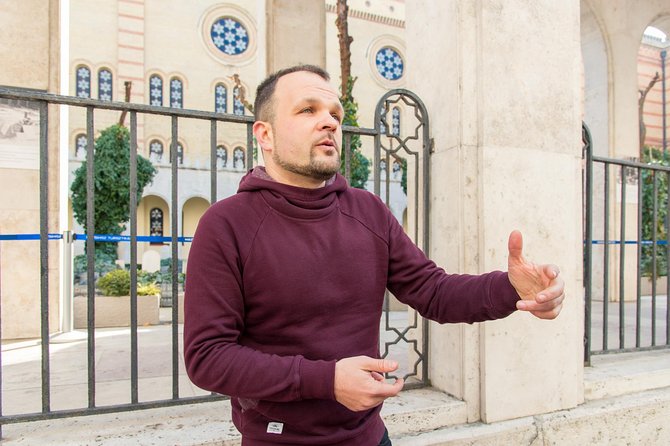
The meeting point is outside the Kempinski Hotel Corvinus Budapest at Erzsébet tér 7-8. The start time is 10:00 am, and the first stop remains in or around this central Pest square for about 20 minutes.
Erzsébet tér began as a medieval market square and is now one of central Pest’s main public spaces. That makes it a useful opening point. Before you enter the Jewish Quarter, you get a sense of Budapest as a city shaped by trade, movement, and changing urban life.
I like this kind of beginning because it gives the history a physical setting. You are not starting with a list of dates. You are starting in a public square that helps explain why communities, businesses, and travelers came together here.
The first stop has no admission fee. You should still wear comfortable shoes, since the route continues on foot through several streets and courtyards.
Raoul Wallenberg’s statue and the hard work of memory
The next stop is Raoul Wallenberg’s statue, with about 10 minutes set aside for it. Wallenberg was the Swedish diplomat who worked to save Jewish lives in Budapest during the Second World War.
Ten minutes may not sound long, but a statue stop is often most useful when it opens a larger subject. Here, the guide can explain Wallenberg’s role within the wider story of rescue, persecution, and international action in Budapest.
This is one of the tour’s strongest choices. The focus is not only on buildings and community life. It also includes the people who took risks during a terrible period. At the same time, you should expect a short stop rather than an extended memorial visit.
The subject is serious, and the guide’s approach matters. The information supplied about Gabor’s guiding points to an open account of Hungary’s past, including its failures as well as its achievements. That kind of direct treatment is valuable on a tour dealing with wartime history.
Szimpla Kert: from Jewish Quarter to ruin-bar district
The 20-minute stop at Szimpla Kert brings you into modern Budapest. It is identified as the first ruin bar in Budapest, and thus the origin point for the city’s famous ruin-bar movement.
The point is not only to have a drink. Szimpla Kert helps show how the old Jewish Quarter changed after years of decline and neglect. An abandoned or worn building can acquire a new life as a social space, and this bar became a major part of Budapest’s modern identity.
I appreciate this contrast. A tour that discusses Jewish Budapest only through memorials can leave you with a narrow picture of the neighborhood. Szimpla Kert shows the district as a living part of the city, with new uses layered onto older streets and buildings.
The drawback is that a 20-minute visit gives you an introduction, not a full evening. You are seeing the place in the context of the walking route. If you want to explore the bar at leisure, return later on your own.
More of the past around Budapest:
- Budapest: Historic Cruise with Welcome Drink
★ 4.7 · 6,512 reviews - Budapest Historical Sightseeing – Free Walking Tour
★ 5.0 · 1,302 reviews - Buda Castle District Dark History, Legends and Vampire Night Tour
★ 4.5 · 1,240 reviews - BloodThirsty Hungary: Walking tour & Dark Historical Stories
★ 4.9 · 633 reviews
Gozsdu Udvar and the international side of the district
Gozsdu Udvar receives about 10 minutes. It is described as one of Budapest’s most international streets, and it helps connect the historical quarter with the city you see today.
This passage of courtyards and businesses is useful because it shows how the area has become a meeting place for different cultures and interests. The guide can place it beside the Jewish history of the neighborhood instead of treating the past as something sealed off from the present.
Ten minutes is enough for orientation, but not for a full exploration of every courtyard or shop. Think of this stop as a bridge. You are moving from the district’s contemporary social life toward its religious and communal landmarks.
Kazinczy Street Synagogue and the Orthodox community
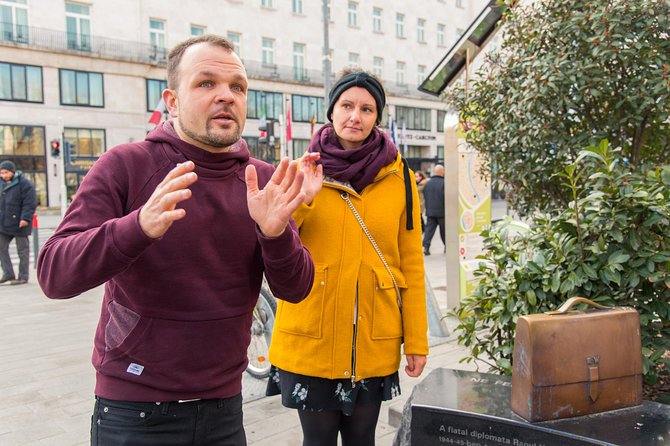
The tour spends around 20 minutes at Kazinczy Street Synagogue, where the focus is the Orthodox Jewish community. This is an important distinction. Jewish life in Budapest was never one single, uniform tradition.
A discussion here can help you understand how different communities maintained their own religious practices, institutions, and identities. The synagogue also gives the tour a chance to move beyond general statements about Jewish Budapest and look at a specific community.
Admission to Kazinczy Street Synagogue is not included. The information provided does not say that the group enters, so you should treat this as a guided exterior stop unless the provider confirms otherwise. If seeing the interior is a priority, ask before booking or arrange a separate visit.
That extra cost is worth considering when you compare the $64.71 price. The tour fee pays for the guide, the small-group format, and the pastry tasting, but not every synagogue ticket.
The Great Synagogue and the limits of the visit
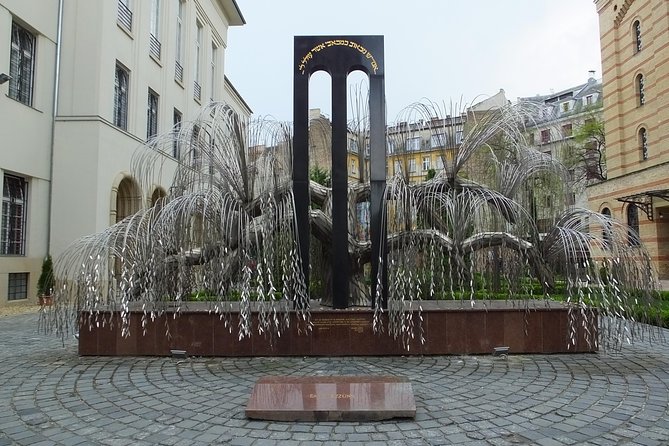
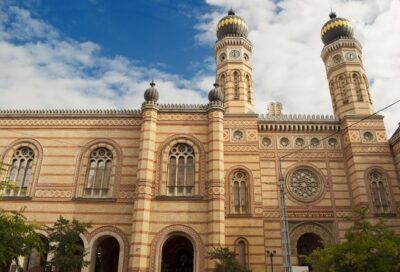
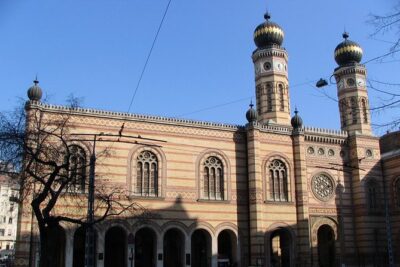
The Great, or Central, Synagogue on Dohány Street receives the longest stop, about 45 minutes. It is described as Europe’s largest synagogue and as a building tied to roughly 200 years of history.
This is likely the visual center of the tour. Even from outside, the scale and importance of the building make it a powerful place to pause. A good guide can explain how the synagogue fits into Budapest’s Jewish community, the city’s political history, and the tragedies of the twentieth century.
But you do not visit the Great Synagogue inside. That point should guide your booking decision. If your main goal is to see the interior, this walk alone will not meet it.
Admission is also not included. You can use the tour as an introduction, then return for an independent visit if timing and opening arrangements allow. The benefit is that you first learn what you are looking at. The cost is that you will pay separately for the interior experience.
The 45-minute discussion gives the guide time to connect architecture with events and people. It also gives you a chance to ask questions. The group size matters most here, since the subject can quickly become more interesting when you can pause and ask about family history, religious differences, or the wartime period.
Flódni at Solinfo Café
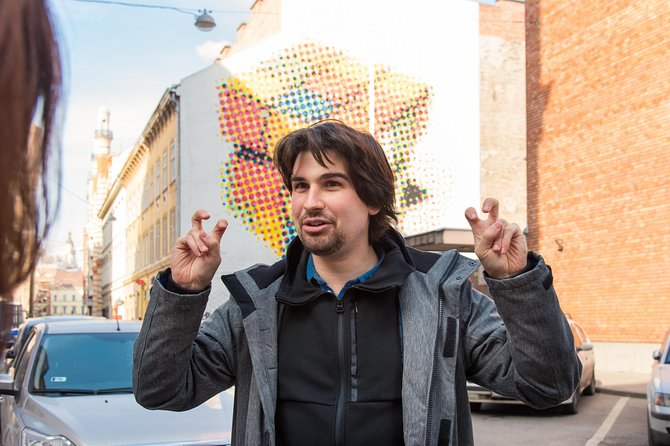
The final listed stop is Solinfo Café, where you try flódni, a Jewish-Hungarian cake. This tasting is included in the price and lasts about 20 minutes.
Flódni is known for its layered pastry and fillings, and it is a fitting finish because food often explains cultural exchange better than a lecture can. The snack gives you a small, concrete connection to Jewish life in Hungary.
I like that the tour ends with something edible and ordinary. After difficult material, you get a moment to talk, taste, and process what you have seen. It also gives the morning a clear finish rather than ending abruptly outside a monument.
The information does not specify the portion size or whether alternatives are available. If you have dietary restrictions, ask the provider before booking. Do not assume the tasting can be changed.
How the $64.71 price compares with the experience
At $64.71 per person, this is not the cheapest way to walk through the Jewish Quarter. It is also not merely a paid stroll between famous addresses.
The price includes a 2.5-hour English-language tour, a historian guide, a group capped at 10 people, and flódni at Solinfo Café. Those elements make the cost easier to justify if you value questions, explanation, and a quieter pace.
You are paying for interpretation more than entry tickets. The Kazinczy Street and Great Synagogue admissions are not included, and the Great Synagogue interior is not part of the experience. If you add those visits later, your total Budapest sightseeing budget will rise.
I see the value most clearly for a first visit to Budapest, or for anyone who wants a careful introduction before exploring independently. The small group is a real benefit. A large group could cover the same streets, but it would be harder to ask about a family connection, a religious tradition, or a troubling historical detail.
The fact that the experience is often booked 42 days ahead suggests you should not leave it until the last minute if the date matters to you. The maximum group size is 10, so availability can be tighter than with a large city walk.
Timing, meeting point, and practical details
The tour begins at 10:00 am outside the Kempinski Hotel Corvinus Budapest, at Erzsébet tér 7-8. It ends outside the Dohány Street Synagogue at Wesselényi utca 1.
That ending point is useful. You are already in the Jewish Quarter, so you can continue exploring, find lunch, return to the Great Synagogue area, or make your way to another part of Budapest.
The tour is near public transportation, and most people can take part. Service animals are allowed. You receive confirmation at booking, and the activity is offered in English with a mobile ticket.
Free cancellation is available if you cancel at least 24 hours before the 10:00 am start time. Cancellations or changes made less than 24 hours before the start are not accepted for a refund.
Because the route includes outdoor walking and several stops, I would choose comfortable shoes and allow a little flexibility after the stated finish. The official duration is approximate, and questions at the synagogues can affect the pace.
Who will get the most from this tour
I would choose this experience if you want Jewish Budapest placed in a wider Hungarian setting. It suits you particularly well if you prefer a small, discussion-friendly group to a large procession.
It is also a good choice if you want more than Holocaust history. The route covers Jewish communities, the Orthodox tradition, rescue work, architecture, urban change, and food. The difficult years remain central, but they are not the only subject.
You may want something else if your main goal is interior access to synagogues. Since the Great Synagogue is viewed from outside and admissions are separate, a dedicated synagogue visit may be better for you.
This tour also suits people who enjoy a guide with a human approach. The strongest guide comments point to patience, warmth, clear answers, and a willingness to discuss both the admirable and painful parts of Hungarian history. Those qualities matter more here than a fast list of facts.
Should you book Jewish Heritage in Hungary with a Historian?
Book it if you want a focused introduction to Budapest’s Jewish Quarter, with time for questions and a guide who can connect centuries of history to present-day streets.
The best reasons are the 10-person limit, the broad historical scope, the Wallenberg stop, the contrast between synagogues and Szimpla Kert, and the included flódni tasting. The main cautions are the $64.71 price, the separate synagogue admissions, and the fact that you do not enter the Great Synagogue.
For many people, I would use this as the morning that gives shape to the neighborhood. Then I would decide afterward whether the Great Synagogue interior deserves a separate visit.
FAQ
How long does the Jewish Heritage in Hungary tour last?
The tour lasts approximately 2 hours and 30 minutes.
What time does the tour begin?
It starts at 10:00 am.
Where does the tour begin?
The meeting point is Kempinski Hotel Corvinus Budapest, Erzsébet tér 7-8, 1051 Budapest.
Where does the tour end?
It ends outside Dohány Street Synagogue at Wesselényi utca 1, 1077 Budapest.
Is the tour offered in English?
Yes. The experience is offered in English.
How large is the group?
The group has a maximum of 10 people.
Do I enter the Great Synagogue?
No. The Great Synagogue is viewed from outside, and you do not visit its interior as part of this tour.
Is the flódni tasting included?
Yes. The tasting at Solinfo Café is included in the tour price.
Just added around Budapest
- Walk to recent and aged spiritual sanctuaries near Budapest★ 5.0 · 5 reviews
- Budapest: Private Walking Tour with a Local Guide★ 3.6 · 6 reviews
- Budapest: City Bike Tour with Coffee Stop★ 5.0 · 37 reviews
- Budapest: Danube River Views Bike Ride★ 4.8 · 23 reviews
- From Budapest: Guided Tour of Eger with Wine Tasting★ 4.5 · 6 reviews
- Trash Art Museum: Hungary’s First Scrap Metal Exhibition★ 4.3 · 72 reviews
- True Crime Walking Tour in the Buda Castle district★ 5.0 · 26 reviews
- Budapest: 3-Hour Trabant Sightseeing Tour★ 4.7 · 28 reviews
Jewish Quarter Tours, compared.
Budapest Jewish Heritage Memorial Walking Tour & Synagogue Entry
Read our review →
Jewish Heritage Guided Tour with Synagogue Ticket
Read our review →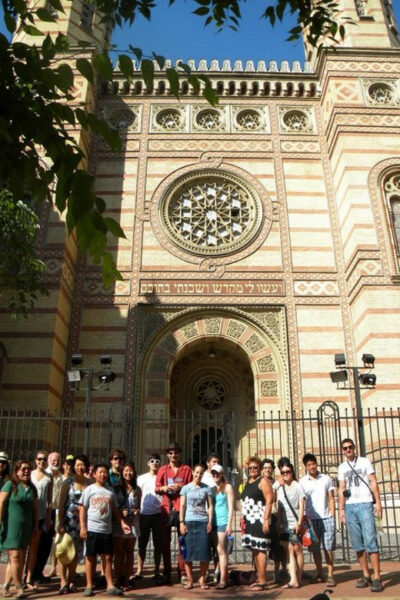
Past and Present of Budapest Jewish District Tour
Read our review →
Budapest Dohany Synagogue & Hungarian Jewish Museum & free extras
Read our review →
Jewish History Guided Walking Tour with Historian
Read our review →Browse the lists this tour appears in