
Reviewed · JEWISH QUARTER TOURS
Budapest Jewish Cuisine & Culture Walk
Budapest’s old Jewish quarter is best understood on foot, with a guide who can connect its pretty facades and lively bars to the painful story beneath them. This tour does that while feeding you well, from flodni and túrós táska to goose soup, solet, wine, and kosher pálinka.
I like the personal scale, since the group is limited to eight and can sometimes be much smaller. I also like the mix of memorials, synagogues, street art, cafés, and local food. The main drawback is that the Dohány Street Synagogue entrance fee is not included, so you may need a separate visit to see its interior.
Key points at a glance
- A four-hour walk through the Seventh District: See the former Jewish ghetto, synagogues, memorials, street art, shops, and food spots in one connected route.
- Food with cultural context: Taste pastries, sausage, goose crackling, solet, goose soup, wine, coffee, and kosher pálinka.
- A small group with room for conversation: The stated maximum is eight people, with the experience sometimes operating almost like a private tour.
- A serious look at WWII history: Memorials and the former ghetto are part of the route, not side notes.
- An English-speaking local guide: Guides named Anna, Orsi, Eszter, Andrew, Daniel, Dora, Elza, and others have led this experience, though your guide depends on the date.
- A useful first-day activity: Your guide provides suggestions for restaurants, sights, books, and further Jewish heritage visits around Budapest.
Why this walk gives Budapest more meaning
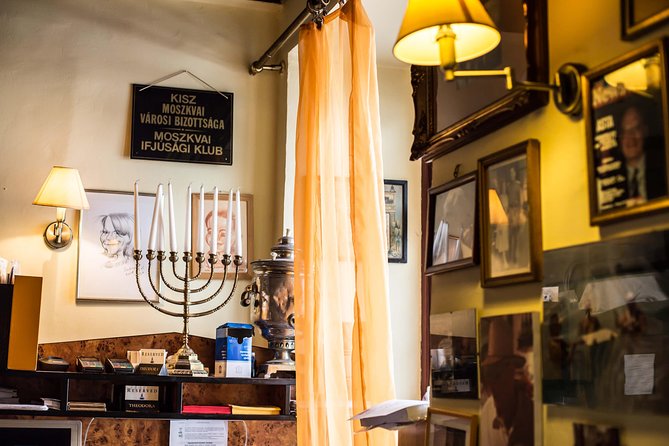
The Seventh District is easy to enjoy on the surface. It has cafés, ruin pubs, restaurants, designer shops, and colorful street art. Yet a few steps can take you from a lively courtyard to a memorial or synagogue tied to the destruction of Budapest’s Jewish community during WWII.
That contrast is the heart of this experience. You are not simply walking past attractive buildings while sampling snacks. Your guide explains how the area grew from medieval Jewish roots into a major center of Jewish life, how it became the wartime ghetto, and how survivors helped rebuild the community after the war.
I like that the food is used as a way into the culture rather than treated as a separate show. A pastry such as flodni can open a conversation about Jewish traditions in Hungary. Solet, a bean stew related to cholent, gives you a taste of a dish designed for Sabbath observance. The meal and tastings make the past easier to approach, but the tour does not skip the hard parts.
The tone also depends heavily on your guide. Past guides named Anna, Orsi, Eszter, Andrew, Daniel, Dora, and Elza have been praised for being warm, clear, well organized, and generous with their time. One guide was completing graduate work in Jewish history, while another was a young Jewish person raised in Budapest. Your guide will vary, but the format allows plenty of questions and conversation.
More of the old Jewish quarter around Budapest:
- Budapest Jewish Heritage Memorial Walking Tour & Synagogue Entry
★ 5.0 · 568 reviews - Budapest: Jewish Heritage Guided Tour with Synagogue Ticket
★ 4.8 · 533 reviews - Jewish Quarter of Budapest Walking Tour
★ 4.7 · 369 reviews
Starting in the Seventh District at 11 a.m.
You meet at Madách Imre tér in central Budapest at 11 a.m. The location is near public transportation, and the tour ends back at the meeting point. From there, your guide leads you into the Seventh District, the center of Budapest’s Jewish community and one of the city’s best-known food and nightlife areas.
This is a good start time for an eating tour, but do not arrive after a large breakfast. The day can include several small tastings, a sit-down lunch, wine, coffee, and pálinka. One particularly useful piece of advice is to eat lightly before you arrive, while still having enough breakfast to walk comfortably for several hours.
The pace is built around stops rather than a long, hard march. You pass leafy streets and neoclassical buildings while your guide explains what you are seeing. The district’s current popularity can make it feel young and fashionable, but the tour keeps bringing you back to the people and institutions that shaped the neighborhood.
The group size matters here. The listed maximum is eight, though some departures have had only two or three people. A small group makes it easier to hear your guide in busy streets and lets you ask about subjects that interest you, from Jewish religious practice to modern Hungarian food.
Synagogues, memorials, and the former ghetto
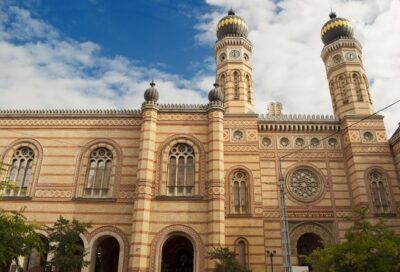
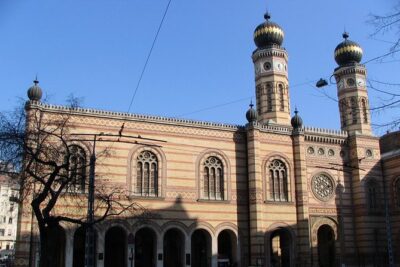
The route includes views of several Jewish sites and the exterior of the Moorish-style Dohány Street Synagogue, Europe’s largest synagogue. Its scale and ornate design make it an important landmark even if you only see the outside during this tour.
Pay close attention to the wording about admission. A synagogue entrance fee is listed among the inclusions, but the admission fee to the Dohány Grand Synagogue is specifically excluded. That means you should not assume this four-hour walk includes the full interior visit, museum, or grounds at Dohány.
This is not necessarily a flaw. The walk is already full, and you can plan a separate visit to Dohány on a day when it fits your schedule. One practical note is that the main synagogue and museum may be closed on Saturday, the Sabbath. If your tour falls on Saturday, the guide can still show you the neighborhood and explain its sites, but you should arrange the interior visit separately and check opening details before you go.
The WWII memorials add weight to the food stops that follow. You see places that honor the Jewish victims of the war and hear how the district became a ghetto. The experience does not offer a full museum treatment of the Holocaust, but it gives you a street-level introduction to what happened in this part of Budapest.
I appreciate that the guide also explains Budapest and Hungary beyond the Jewish quarter. The strongest version of this tour is not just a list of Jewish landmarks. It helps you understand how the city changed over time, how Jewish life fit into Budapest, and how the district became the social center it is today.
Pastries, sausage, and goose crackling
The tasting stops vary by day and availability. That flexibility is useful because it allows the guide to work with open shops and current food options, but it also means you should not expect a fixed menu.
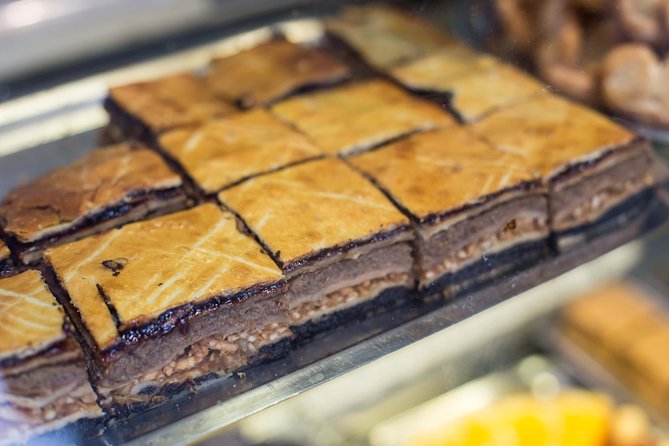
Possible sweet tastes include flodni and túrós táska. Flodni is a layered pastry associated with Hungarian Jewish baking, while túrós táska is a curd-cheese pastry. These are the sort of foods that are easy to pass in a bakery without knowing their background. With a guide, they become part of the story of the neighborhood.
Savory tastings may include sausage and goose crackling. Goose appears again at lunch, reflecting the role of goose dishes in Hungarian Jewish cooking. The food is not designed as a formal tasting menu with identical portions for every departure. Think of it as a series of stops that builds toward lunch.
Here, the tour has one important uncertainty. Most food experiences vary in quality from day to day, and one past departure included snacks that felt disappointing and not especially Jewish. That does not cancel out the stronger food reports, but it is fair to say that the culinary side is less fixed than the description may suggest.
Dietary needs should be given when you book. The supplied information does not promise a particular substitute, so do not wait until the meeting point to explain allergies or restrictions.
Other guided walks around Budapest:
- Budapest: Buda Castle Walk with Saint Stephen’s Hall
★ 4.5 · 3,012 reviews - Big Bus Budapest Hop-On Hop-Off Bus and Walking Tour
★ 3.5 · 2,206 reviews - Budapest: Buda Castle District Walking Tour
★ 4.6 · 2,108 reviews - Budapest City Landmarks Walking Tour in 2 Hours
★ 5.0 · 2,048 reviews
Street art, cafés, and the neighborhood today
Between food stops, you see the modern face of the district. Street art and designer shops show how the former ghetto has become one of Budapest’s trendiest areas. Cafés, restaurants, and ruin pubs fill buildings that also carry reminders of earlier generations.
This contrast is one of the most useful parts of the walk. You see the neighborhood as a living place, not only as a memorial zone. The guide can point out how the surviving community helped lay the groundwork for the restaurants, cultural spots, and Jewish institutions found here today.
The ruin pubs are especially tied to Budapest’s current identity. They can look playful and improvised, but this tour places them beside the quarter’s older religious and communal sites. That makes the modern scene easier to read. You are not asked to choose between history and contemporary Budapest. You see both in the same few streets.
A Jewish-style lunch at Tasting Table Budapest
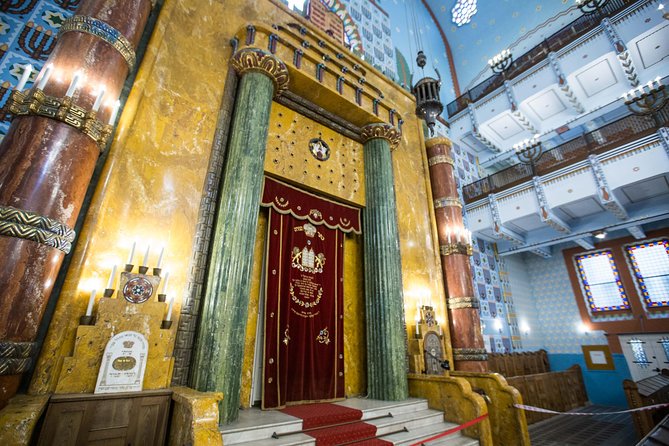
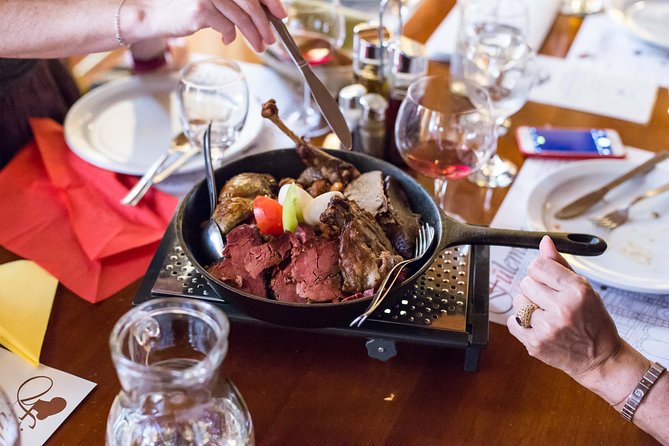
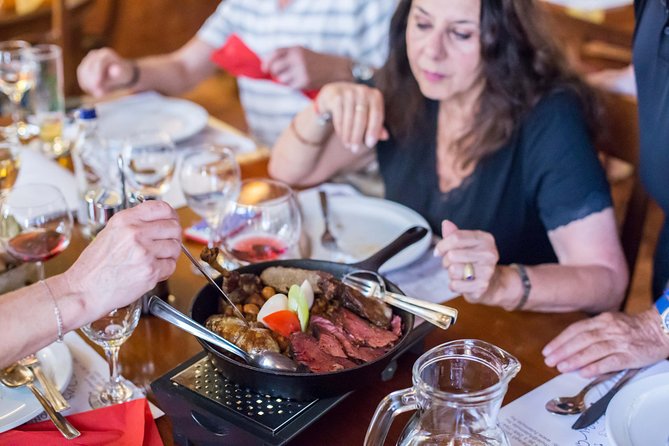
The lunch is the main sit-down food stop. The supplied details place it at Tasting Table Budapest, described as a restaurant and wine cellar, with a meal that may include goose soup and solet, a Hungarian version of bean stew.
Other food noted for one departure included matzo ball soup, cholent, and brisket. The exact meal can change, so you should think in terms of traditional Jewish and Hungarian dishes rather than one guaranteed plate.
Solet is especially fitting for the theme. It is a slow-cooked bean dish related to the broader Jewish tradition of cholent, prepared so it could be eaten on the Sabbath. The meal gives you a chance to ask about ingredients, customs, and the way Jewish cooking adapted to Hungarian surroundings.
Wine is included with lunch, and the meal is meant to be social. You sit with your guide and companions rather than grabbing another item in the street. For me, this is where the experience earns much of its price. You are paying not only for a meal, but also for the interpretation and conversation that make the dishes useful.
The lunch has not pleased everyone equally. One person found the selection less appealing, while others considered the food a highlight. If you have strong preferences, tell the operator about them in advance, but keep in mind that the menu is part of a set cultural experience rather than a restaurant chosen solely for personal taste.
Coffee, wine, and kosher pálinka
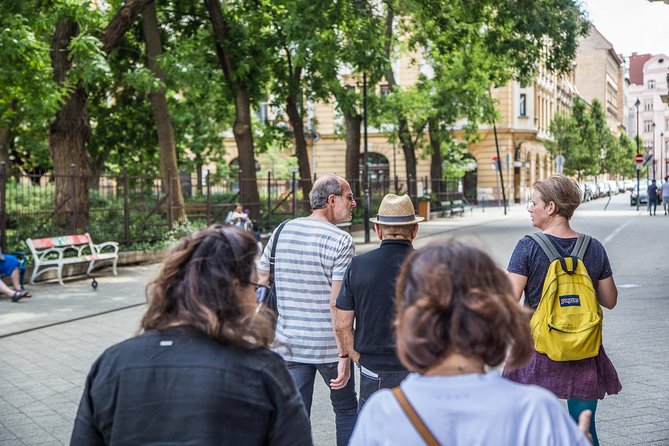
After lunch, the route includes a coffee stop. This is a sensible pause, since four hours of walking and eating can catch up with you. The final drink is kosher pálinka at a ruin pub or local wine bar.
Pálinka is a strong Hungarian fruit brandy, so this is a small tasting, not a reason to skip water. The stop gives you a chance to talk with your guide and get suggestions for the rest of your stay. Past guides have offered ideas about other places to eat, sights to see, and books to read.
That advice can be especially useful if you take the tour early in your Budapest visit. You may leave with a better sense of which cafés, restaurants, synagogues, and cultural sites deserve another look. The route ends at the starting point, so you can continue exploring the central districts afterward.
Is the $155 price fair?
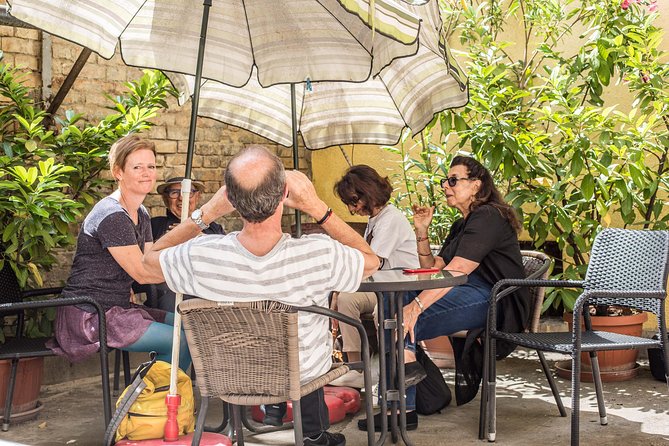
At $155 per person, this is not a cheap walking tour. It is also more than a basic neighborhood walk with one pastry and a coffee. The price includes an expert English-speaking guide, several food tastings, drinks, lunch with wine, and a small-group format.
The value improves when the group is tiny. If only two or three people book, you may receive something close to a private tour without paying a full private-tour rate. Several departures have lasted longer than the advertised four hours, but you should treat four hours as the official duration rather than count on extra time.
The price makes less sense if you want a full interior visit to Dohány included or if you are mainly seeking a large number of high-end dishes. The Dohány admission cost is separate, and the tasting menu changes. For a fixed synagogue tour plus a fixed restaurant menu, choose a different product.
For an in-depth introduction to Jewish Budapest, however, the combination is strong. You get context, food, a meal, drinks, and a guide who can adjust the conversation to your interests. I would consider it good value for people who want an experience that connects several parts of the city rather than a quick sightseeing loop.
Practical details before you book
The tour is offered in English and requires at least two people to operate. If the minimum is not met, the activity may be canceled after confirmation, with an alternative date or experience, or a full refund offered.
The stated maximum is eight people, though another description presents it as limited to six. Either way, this is intended to be a small group, not a large coach outing. Most people can participate, but you should expect several hours on foot with repeated standing and walking.
The tour is non-refundable and cannot be changed for any reason after booking. Check your date carefully before paying. Also provide dietary requirements at booking, and confirm the synagogue plan if you care about seeing the Dohány interior.
Who should book this experience?
I would choose this tour for you if food helps you understand a place, you want serious historical context, and you prefer a small group. It suits first-time visitors who want orientation, as well as returning visitors who have seen the main Budapest sights but have not explored the Jewish quarter carefully.
It is also a good fit if you want a local guide rather than a self-guided route. The guides have covered not only Jewish life, but also Hungarian food, Budapest history, and present-day city culture.
I would hesitate if you need a guaranteed menu, have strict dietary requirements that cannot be accommodated, or expect entrance to Dohány to be part of the $155 price. I would also avoid booking it as your only synagogue visit. Use the walk for context, then return separately to the sites whose interiors you want to see.
Should you book the Budapest Jewish Cuisine & Culture Walk?
Book it if you want Budapest’s Jewish quarter explained through both memory and food. The memorials and former ghetto give the walk gravity, while pastries, goose, solet, wine, coffee, and pálinka keep it grounded in daily culture.
Plan it near the start of your stay, eat a light breakfast, and keep room in your schedule for a separate Dohány Synagogue visit. At $155, the tour is a considered purchase, but the small group, substantial meal, and adaptable local guidance can make it worthwhile. If you prefer a fixed menu or a complete synagogue admission package, this is not the right choice.
FAQ
Where does the tour start?
The tour starts at Madách Imre tér in Budapest’s Seventh District.
What time does the tour begin?
The scheduled start time is 11 a.m.
How long does the experience last?
The listed duration is approximately four hours. Some departures have lasted longer, but four hours is the stated duration.
What language is the tour offered in?
The tour is offered in English.
How many people can join the group?
The maximum listed group size is eight people. The experience is designed as a small-group tour, and some departures may have only two or three participants.
Is lunch included?
Yes. Lunch with wine is included. Possible dishes include goose soup and solet, with other departures offering foods such as matzo ball soup, cholent, or brisket.
What foods might I taste?
Possible tastings include flodni, túrós táska, sausage, and goose crackling. The exact selection varies according to the day and availability.
Is the Dohány Street Synagogue admission included?
The entrance fee to the Dohány Grand Synagogue is specifically not included. The experience does include an entrance fee to a synagogue, but you should plan separately if you want to visit Dohány’s interior.
Can I join if I have dietary requirements?
You should provide any specific dietary requirements when booking. The supplied information does not guarantee a particular replacement menu.
Can I cancel after booking?
The experience is non-refundable and cannot be changed for any reason. If the operator cancels because the minimum number of participants is not met, you will be offered an alternative or a full refund.
Just added around Budapest
- Walk to recent and aged spiritual sanctuaries near Budapest★ 5.0 · 5 reviews
- Budapest: Private Walking Tour with a Local Guide★ 3.6 · 6 reviews
- Budapest: City Bike Tour with Coffee Stop★ 5.0 · 37 reviews
- Budapest: Danube River Views Bike Ride★ 4.8 · 23 reviews
- From Budapest: Guided Tour of Eger with Wine Tasting★ 4.5 · 6 reviews
- Trash Art Museum: Hungary’s First Scrap Metal Exhibition★ 4.3 · 72 reviews
- True Crime Walking Tour in the Buda Castle district★ 5.0 · 26 reviews
- Budapest: 3-Hour Trabant Sightseeing Tour★ 4.7 · 28 reviews
Jewish Quarter Tours, compared.
Budapest Jewish Heritage Memorial Walking Tour & Synagogue Entry
Read our review →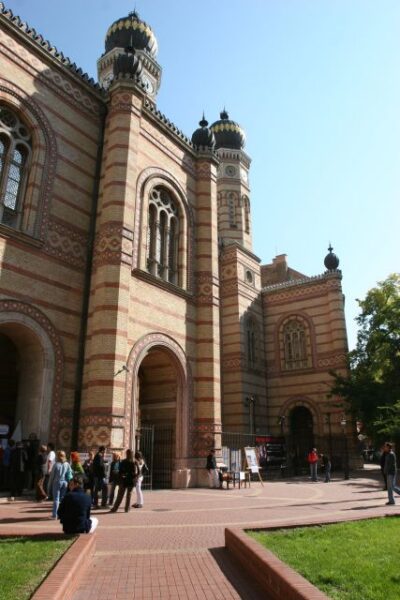
Jewish Heritage Guided Tour with Synagogue Ticket
Read our review →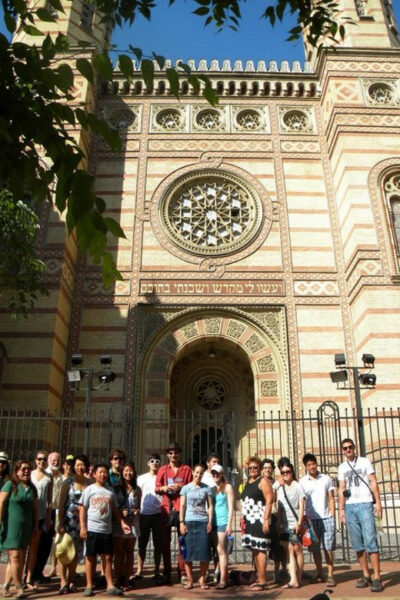
Past and Present of Budapest Jewish District Tour
Read our review →
Budapest Dohany Synagogue & Hungarian Jewish Museum & free extras
Read our review →
Jewish History Guided Walking Tour with Historian
Read our review →Browse the lists this tour appears in