
Reviewed · TOURS IN BUDAPEST
Audio visual multi-sensory chefs journey dinner experience
The cleverest part of this Budapest evening is the setting: you pass through a secret door behind a wardrobe and enter a room where walls, sound, and food carry you from Hungary to Brazil. This is not simply dinner with background music. The room itself changes the mood of each course.
I like the small maximum group of 24, which should keep the service focused, and I like the wide menu, from Hungarian foie gras and Russian trout to Japanese tuna, Chinese dim sum, American beef, and a Brazilian coffee dessert. The main consideration is cost: at $169.30 per person before beverages, this is a special-occasion meal, not a casual Budapest dinner.
Key points to know before booking
- Seven courses trace a route from Hungary through Russia, Spain, Japan, China, the USA, and Brazil.
- A concealed entrance adds a speakeasy-style beginning before the meal starts.
- 360-degree projections and native music accompany each destination.
- The menu includes foie gras, caviar, octopus, tuna, duck, beef, and dessert with coffee and banana.
- Dinner lasts about two and a half hours, beginning at 7:30 pm and ending back at Caviar & Bull Budapest.
- Drinks are not included, so your final bill will be higher than the listed dinner price.
A secret entrance sets the tone at 7:30 pm
Your evening begins at Caviar & Bull Budapest, at Erzsébet krt. 43-49 in the 7th district. The start time is 7:30 pm, and the experience returns to this same location rather than moving around Budapest.
The entrance is part of the fun. A wardrobe conceals the way into the dining room, giving the night a speakeasy feel before the first plate arrives. That small theatrical touch matters because it separates this meal from a standard tasting menu. You are not only sitting down at a table. You are being led into a designed story.
The concept comes from Marvin Gauci, a multi-award-winning restaurateur and ambassador for Maltese gastronomy. His idea is to pair a chef’s degustation with large-scale visual scenes and music linked to the places represented in the meal.
You should arrive ready for a set experience rather than a flexible restaurant meal. The menu is planned as a sequence, and the room’s projections are part of that sequence. If you prefer choosing individual dishes at your own pace, a conventional restaurant will suit you better.
Other tours you can do at your own pace in Budapest:
- Budapest: Parliament Building Entry Ticket and Audio Guide
★ 4.5 · 3,844 reviews - Budapest Danube Cruise with Drink, Audio Guide, Margaret Island
★ 4.5 · 1,036 reviews - Budapest: Danube River Sightseeing Cruise with Audio Guide
★ 4.1 · 1,002 reviews
Hungary begins with foie gras and paprika
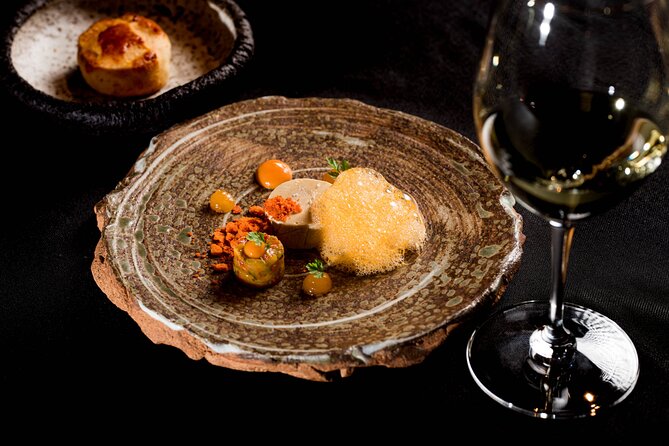
The first course represents Hungary: foie gras with letscho, paprika crumb, and a duck crackling scone. It is a strong opening because the ingredients point clearly toward Hungarian flavors, especially the paprika and letscho.
You can expect a rich start. Foie gras brings a soft, fatty texture, while paprika adds warmth and the duck crackling scone brings crunch. The dish is more than a token national reference. It uses recognizable regional flavors in a polished tasting-menu format.
This opening also gives the room a chance to establish its visual language. The experience begins in Hungary before moving outward, so the first course serves as your point of reference. You start locally, then move across several continents without leaving Budapest.
The drawback is that rich food arrives early. If you find foie gras heavy, the first course may feel more intense than a light amuse-bouche. Still, the portion is part of a seven-course progression, not a full entrée.
Russia brings trout, beetroot, and caviar
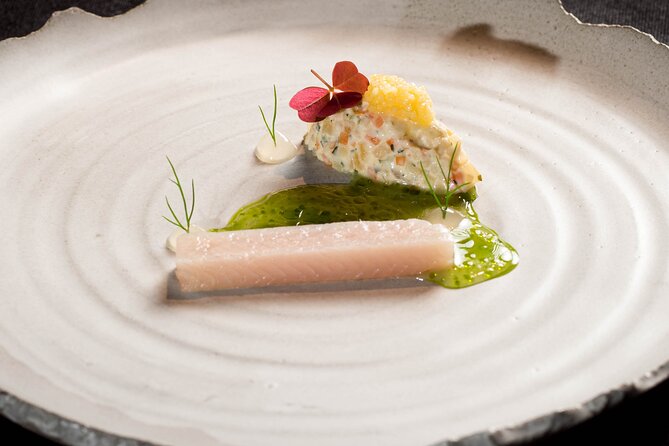
The Russian course features trout fillet, golden beetroot, a root-vegetable salad, cucumber, celery and apple sauce, and sturgeon caviar. This is a more delicate plate than the opening course, with freshwater fish, earthy vegetables, crisp produce, and a luxury garnish.
I like the contrast built into this course. The golden beetroot and root vegetables should give the plate a grounded, autumnal character, while cucumber, apple, and celery keep the sauce fresh. Sturgeon caviar adds salt and a clear sense of occasion.
The dish also shows why the menu is designed as a world journey rather than a collection of unrelated restaurant specials. Each stop has its own ingredients and mood. Russia follows Hungary with a change in texture and balance, keeping the meal from becoming a series of similarly rich plates.
You should note that caviar and trout may be important factors for anyone with seafood preferences or restrictions. The available information does not specify substitutions, so ask the provider in advance if you need a modified menu.
Spain arrives with octopus and citrus
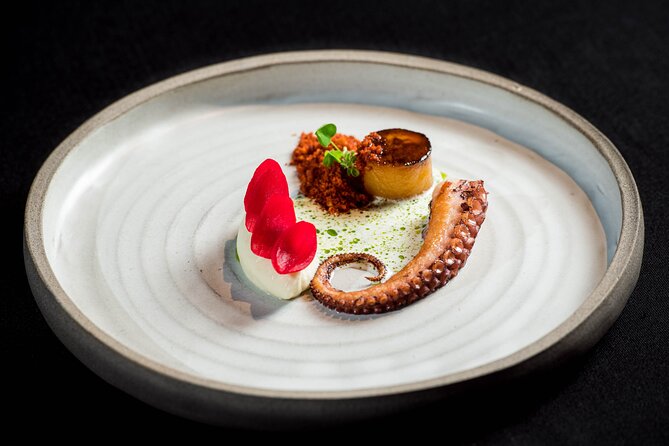
Spain is represented by chargrilled octopus, chorizo crumb, cauliflower, marinated shallot, fondant potatoes, and citrus veloutee. This is one of the more layered dishes in the meal, combining smoky seafood with sausage spice, creamy vegetables, potato, acidity, and citrus.
The octopus gives the course a firm, grilled center. Chorizo crumb adds savory heat, while the marinated shallot and citrus sauce should keep the flavors from feeling too weighty. Fondant potatoes add a soft, buttery element, and cauliflower ties the plate together.
This is the kind of dish that makes the menu appealing to people who enjoy chef-led tasting meals. You get a recognizable Spanish direction, but not a basic plate of tapas. The ingredients are arranged to create several textures in one small course.
The program moves quickly across cultures, so the national labels are broad rather than a full account of each cuisine. Spain appears through selected flavors, not through a long regional study. That is a fair trade for a single evening covering seven destinations.
Other audio-guided walks around Budapest:
- Parliament Tour in Budapest with Audio Guide
★ 4.0 · 814 reviews - Budapest River Cruise with 1 Free Tokaj Frizzante and Audio Guide
★ 4.5 · 473 reviews - Budapest Paddle Steamer Danube Cruise with Tokaj & Audio Guide
★ 4.5 · 338 reviews - Budapest Audio Guide Cruise with Day, Sunset and Night Options
★ 3.5 · 295 reviews
Japan offers a sharper, lighter course
The Japanese course is tuna tataki with daikon salad, radish tempura, black sesame, shiitake, and wasabi mayonnaise. After foie gras, trout, and octopus, this course gives the meal a fresher and more pointed turn.
Tuna tataki provides a clean center, while daikon and radish add crispness. Black sesame and shiitake bring earthier notes, and wasabi mayonnaise supplies heat and creaminess. The combination should appeal to you if you enjoy Japanese-inspired dishes with both raw and cooked elements.
The radish tempura is a particularly useful detail because it adds crunch to a plate otherwise built around tender fish and vegetables. The course also shows the kitchen using familiar Japanese markers without limiting itself to a strictly traditional presentation.
As with the Russian plate, seafood plays a major role. The menu includes fish, shellfish, and octopus before the meat courses, so this experience is best for people comfortable with seafood. The information provided does not list vegetarian, vegan, or allergy alternatives.
China turns the meal toward duck and dim sum
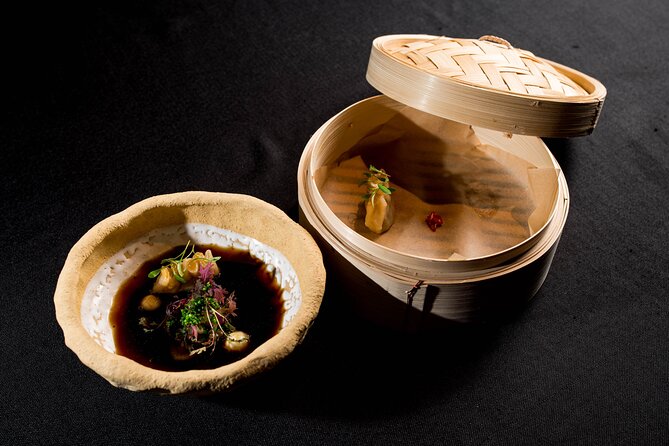
The Chinese course is an aromatic duck consommé with a duck-filled dim sum and shimeji mushrooms. It is served as a main course, although the wording suggests a composed tasting portion rather than a large bowl of soup and a full dumpling plate.
Consommé gives the dish a clear, concentrated base. The duck dumpling adds substance, and shimeji mushrooms supply a gentle earthy note. After the brighter Japanese course, this section should feel warmer and more comforting.
The use of duck across more than one part of the menu is worth noting. Duck appears in the Hungarian opening as a crackling scone and returns here in the broth and dim sum. That repetition creates a quiet thread through the meal, even as the cuisine changes.
The Chinese stop may be one of the more restrained moments visually and on the plate. That is not a weakness. A tasting menu needs pauses between bigger flavors, and a clear broth can reset your palate before the American course.
The USA course brings the heaviest plate
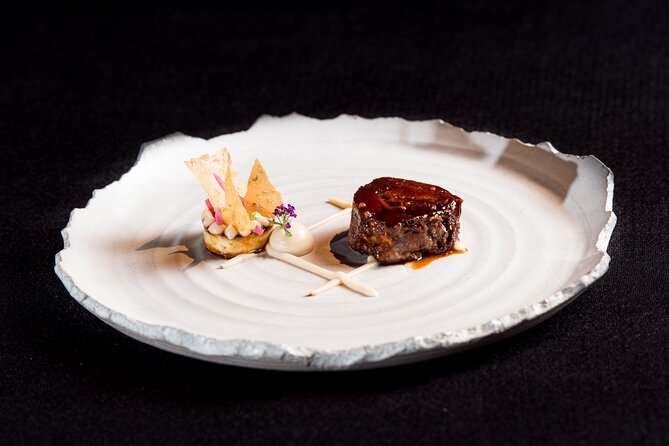
The American main is slow-cooked Omaha beef blade with barbecue celeriac, Jerusalem artichoke crisp, and aromatized jus. This is the meal’s most substantial course, built around tender beef and deep, savory sauce.
Slow cooking suits beef blade, a cut that can become tender when given enough time. Barbecue celeriac gives the plate a root-vegetable base with smoky seasoning, while the Jerusalem artichoke crisp adds texture. The jus ties the components together with concentrated meat flavor.
I like the decision to represent the USA with a carefully cooked beef dish rather than a novelty version of fast food. The course points to barbecue and steakhouse traditions while keeping the presentation in line with the rest of the tasting menu.
This may be the point when the meal feels richest. You have already eaten foie gras, fish, octopus, tuna, and duck, so the full sequence asks a lot of your appetite. The two-and-a-half-hour timing helps, but this is still a substantial dinner. If you eat lightly, the generous range of courses is something to consider before booking.
Brazil closes with coffee, banana, and chocolate
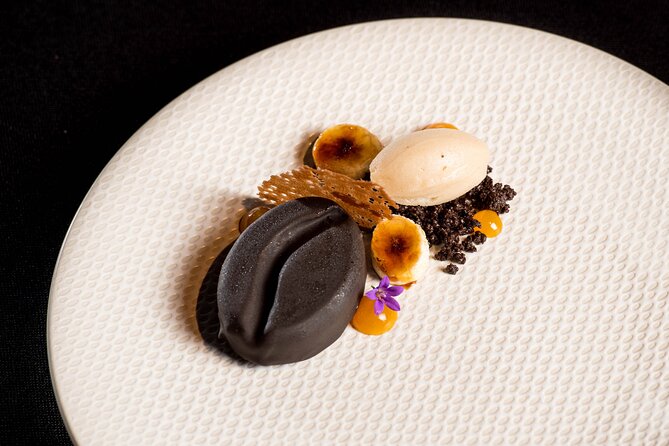
Dessert represents Brazil with a dish called The Ultimate Coffee Bean. It combines banana bread, dark chocolate ganache, coffee crème, and banana sorbet.
This is a sensible final course after the beef. Dark chocolate and coffee bring bitterness and depth, while banana bread and sorbet provide sweetness and a cooler finish. The combination should feel familiar enough to comfort you, but the coffee-centered idea gives it a distinct identity.
The dessert also completes the geographical route. The menu begins in Hungary and ends in South America, making the final course feel like the end of a long movement rather than an unrelated sweet.
It is a fairly assertive dessert, especially for anyone who dislikes coffee or banana. The menu does not list alternative desserts, so ask before booking if either flavor is a problem.
The room is part of every course
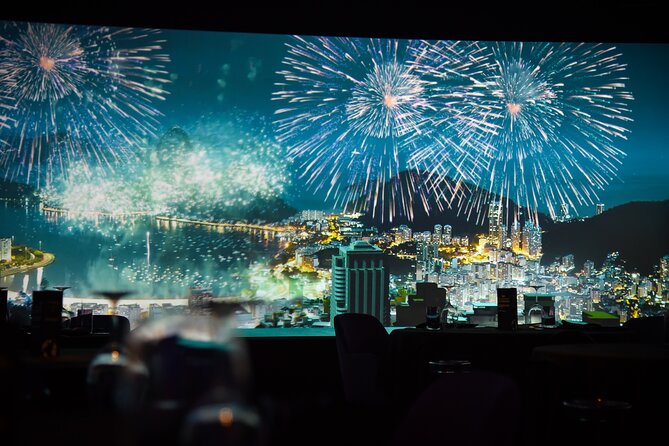
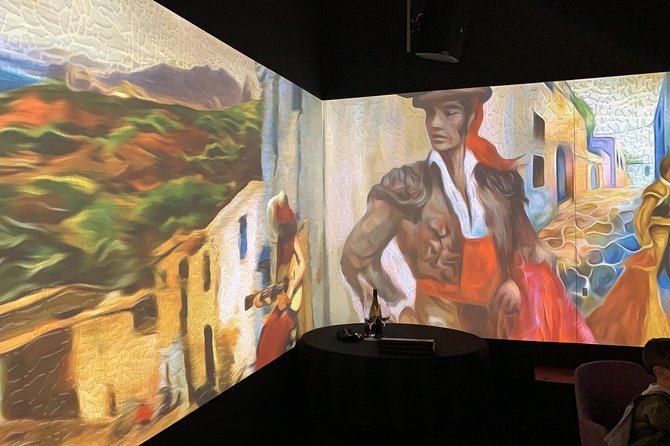
The defining feature is the 360-degree audio-visual show. Projections surround the dining room, and authentic music connects each section to the destination being presented. Instead of looking at one screen, you watch the room change around you.
That design can make the meal feel more like a performance than a normal restaurant visit. It also gives the courses a sense of place, even though the food is served in one Budapest room. The visuals are not an optional decoration. They are the bridge between the menu’s countries.
The experience is likely to suit you if you enjoy food with theater, music, and a strong visual setting. It may be less appealing if you want quiet conversation or prefer to focus only on the plate. The show could compete with table talk, especially during the most active scenes.
The small group limit of 24 is helpful here. A room with a limited number of diners should feel more controlled than a large dinner theater, and attentive service is an important part of keeping the two-and-a-half-hour sequence on track.
Is $169.30 good value?
At $169.30 per person, this costs more than an ordinary Budapest dinner. You are paying for a multi-course menu, the production around it, the service, and the unusual setting. Beverages are not included, so plan for an additional charge if you want wine, cocktails, or other drinks.
I see the price as reasonable for a special night if you value the full package. Seven tasting courses alone can make a premium dinner worthwhile, and this adds a theatrical program that would be difficult to recreate at a standard restaurant.
The value is weaker if you mainly want a large meal or a quiet dining room. The menu is broad and polished, but the portions in a degustation are designed as courses, not as separate full meals. You are buying a food-and-performance experience, not simply the least expensive way to eat well in Budapest.
The fact that the experience is often reserved well ahead, with an average booking time of 76 days, suggests that you should not leave it until the last minute if the date matters. Confirmation is normally sent at booking, though bookings made within six hours of the start time are subject to availability.
Who should book this Budapest dinner?
I would choose this for a couple, a birthday evening, or anyone who likes tasting menus with a theatrical edge. It also works for a small group that wants one memorable night rather than several ordinary restaurant meals.
The menu suits adventurous eaters who enjoy foie gras, caviar, octopus, tuna, duck, beef, coffee, and banana. The country-by-country format gives you variety, but it also means the dinner includes several foods that can be difficult for selective eaters.
You should choose something else if you need a fully vegetarian meal, avoid seafood, dislike visual shows, or want drinks included in the price. The supplied details do not confirm dietary substitutions, so contact Uncensored before booking rather than hoping the kitchen can adjust the sequence.
Public transportation is nearby, and most people can participate. The activity ends at the original meeting point, which keeps the evening simple. Free cancellation is available up to 24 hours before the 7:30 pm start. Inside that window, the amount paid is not refunded, and late changes are not accepted.
Should you book Uncensored: The Journey?
Book it if you want dinner to feel like a small production. The secret wardrobe entrance, 360-degree projections, music, and seven-country menu give you something that a normal tasting restaurant cannot provide.
Skip it if your priority is low cost, quiet conversation, or complete control over the menu. At $169.30 before drinks, it asks for a serious budget. For the right occasion, though, the combination of Hungarian opening dishes, global flavors, polished service, and a room that changes with the meal makes this one of Budapest’s more unusual evening choices.
FAQ
Where does the dinner begin?
The experience begins at Caviar & Bull Budapest, located at Erzsébet krt. 43-49, 1073 Budapest, Hungary.
What time does the experience start?
The start time is 7:30 pm.
How long does the dinner last?
The experience lasts approximately two hours and 30 minutes.
What is included in the price?
The price includes The Journey degustation dinner.
Are beverages included?
No. Beverages are not included in the listed price.
How many people can join the experience?
The activity has a maximum group size of 24 people.
Can I cancel for a full refund?
Yes. You can cancel at least 24 hours before the experience start time for a full refund. Cancellations made less than 24 hours before the start are not refunded.
Just added around Budapest
- Walk to recent and aged spiritual sanctuaries near Budapest★ 5.0 · 5 reviews
- Budapest: Private Walking Tour with a Local Guide★ 3.6 · 6 reviews
- Budapest: City Bike Tour with Coffee Stop★ 5.0 · 37 reviews
- Budapest: Danube River Views Bike Ride★ 4.8 · 23 reviews
- From Budapest: Guided Tour of Eger with Wine Tasting★ 4.5 · 6 reviews
- Trash Art Museum: Hungary’s First Scrap Metal Exhibition★ 4.3 · 72 reviews
- Budapest: 3-Hour Trabant Sightseeing Tour★ 4.7 · 28 reviews
- True Crime Walking Tour in the Buda Castle district★ 5.0 · 26 reviews
Tours in Budapest, compared.


Unlimited Prosecco, Beer and Aperol Spritz Cruise
Read our review →
Széchenyi Spa Day Ticket with Optional Upgrades
Read our review →


Budapest Danube Cruise and Dinner Options, Live Music and Dance
Read our review →

St. Stephen’s Basilica Entry with Terrace Option
Read our review →Browse the lists this tour appears in