
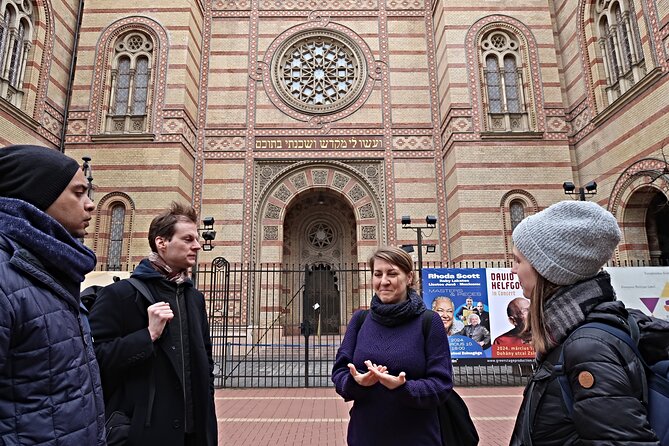
Reviewed · JEWISH QUARTER TOURS
A Journey through Jewish Budapest – Walking Tour
Budapest’s Jewish story is not confined to one synagogue or memorial. This three-hour walking tour connects grand places of worship, traces of the former ghetto, and the quiet Shoes on the Danube memorial to show how Jewish life shaped the city before WWII and how sharply it was torn apart.
I like the tour’s strong historical focus and its range of sites. I also like the chance to walk between them with a historian rather than simply collect photographs. The main caution is cost: the tour is $123 per person, and admission to the Dohány Synagogue, listed at 14,500 forints, is extra.
Key points to know before booking
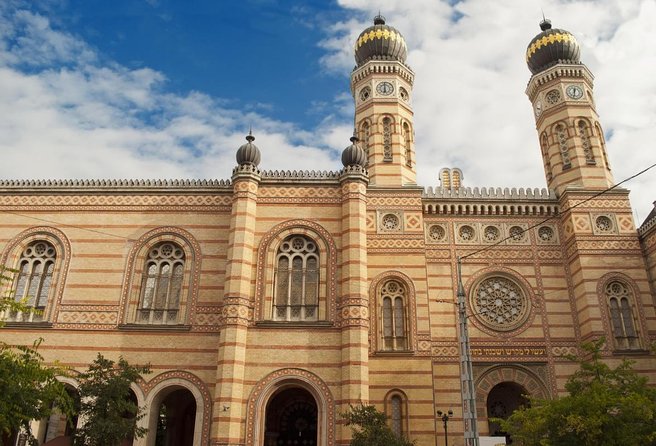
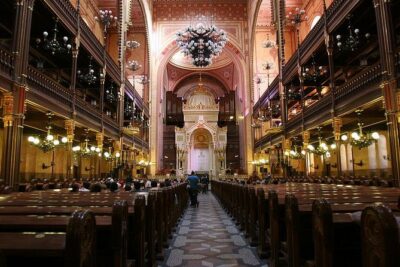
- The Dohány Synagogue is the centerpiece: You see its Moorish Revival interior and the wider complex, including the Jewish Museum, Temple of Heroes, and Memorial Park.
- The tour connects several Jewish traditions: The route introduces the Neolog, Orthodox, and Status Quo Ante strands of Budapest’s Jewish community.
- The guide is the real value: Guides may be professors, doctoral students, historians, journalists, art critics, or published authors.
- The ending is reflective: The Shoes on the Danube memorial gives the tour a quiet, serious finish rather than a rushed final stop.
- The experience can feel personal: Past guide assignments have included Orsolya and Endres, both praised for thoughtful, detailed explanations.
- Dress matters at the synagogue: You need to cover your shoulders and knees when entering the Dohány complex.
Why Jewish Budapest needs more than a synagogue visit
Before WWII, about a quarter of Budapest’s population was Jewish. That single figure changes how you read the city. Jewish life was not a small side story tucked into one neighborhood. It shaped commerce, scholarship, religious practice, architecture, and daily life across central Budapest.
This tour gives you a way to sort through that story. Instead of treating the Holocaust as an isolated chapter, it begins with the many forms of Jewish life that existed before the catastrophe. You hear about different religious movements and see how they expressed themselves through buildings and institutions.
The route also helps you understand that Budapest’s Jewish community was not uniform. The Dohány Street Synagogue, Kazinczy Street Synagogue, and Rumbach Street Synagogue represent different religious settings and periods. That variety is one of the most useful parts of the experience.
I would choose this tour if you want context rather than a quick memorial visit. It is less suitable if you prefer a light city stroll, since the subject includes persecution, deportation, and murder. The tone is serious, but the focus on Jewish life before WWII gives the tour more depth than a tour built only around tragedy.
More of the old Jewish quarter around Budapest:
- Budapest Jewish Heritage Memorial Walking Tour & Synagogue Entry
★ 5.0 · 568 reviews - Budapest: Jewish Heritage Guided Tour with Synagogue Ticket
★ 4.8 · 533 reviews - Jewish Quarter of Budapest Walking Tour
★ 4.7 · 369 reviews
Starting near Madách Imre Way
The meeting point is Kamara Café at Dohány utca 1/A. The route then begins around Madách Imre Way, at the square associated with Theodor Herzl, the father of modern Zionism. Herzl was born here, so the opening stop places a major figure in a real Budapest setting rather than presenting him as a distant name in a textbook.
Your guide sets up the city’s Jewish story from this starting point. The exact meeting arrangements depend on the option you book, so check the selected time and starting point carefully.
The walking is central to the experience. You move through streets where the buildings themselves provide clues, then stop for explanation. That format works well in Budapest because the distance between key Jewish sites is manageable within a three-hour tour.
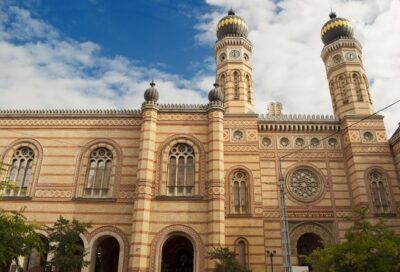
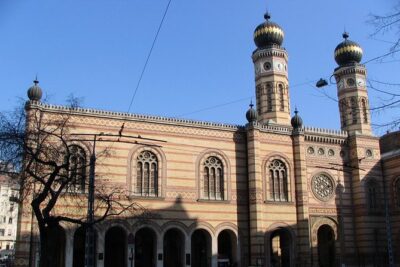
Entering the Dohány Street Synagogue complex
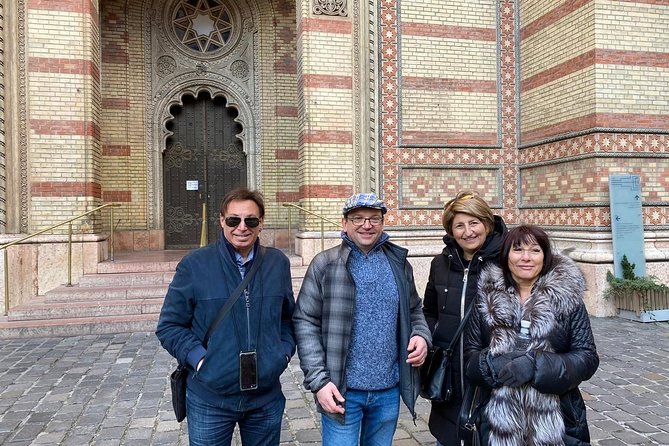
The Dohány Street Synagogue is the major stop, and admission is not included in the tour price. The listed individual ticket is 14,500 forints, so include that cost when comparing this experience with other Budapest tours.
Inside, the synagogue’s Moorish Revival design makes an immediate impression. It is described as the largest temple in Europe, and the scale and decoration give you a clear sense that this was built for a large, established urban community. Your guide explains the building rather than leaving you to admire the facade without context.
The tour includes help from a Jewish Studies scholar at the synagogue. That matters because the building is not simply an architectural stop. Its design, use, and place within Budapest’s Jewish community all connect to the wider history being discussed.
The complex includes more than the main worship space. You visit the Temple of Heroes, the Jewish Museum, and a Memorial Park. Each adds a different layer:
- The Temple of Heroes links the site to Jewish soldiers and the losses of World War I.
- The Jewish Museum gives the community’s traditions and objects a physical setting.
- The Memorial Park turns the visit toward the destruction of Jewish life during the Holocaust.
The complex can take time to absorb, and that is one reason a guide helps. You are not just moving from one room to another. You are being shown how religious, cultural, and memorial spaces fit together.
Dress respectfully. Visitors to the Dohány Synagogue are asked to cover their shoulders and knees. This is an important practical point, especially if you are planning the tour on a warm Budapest day.
The 2014 ghetto wall memorial
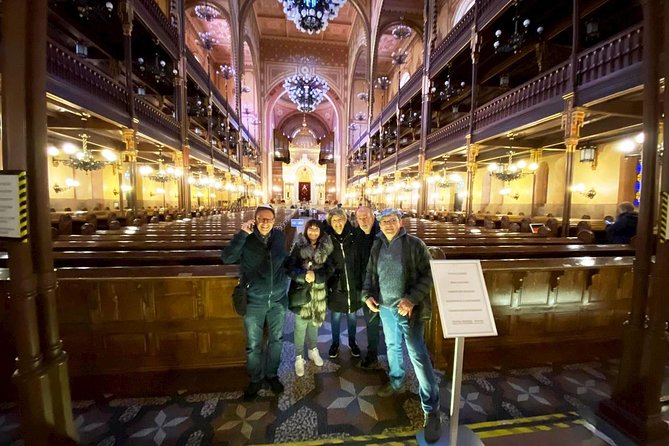
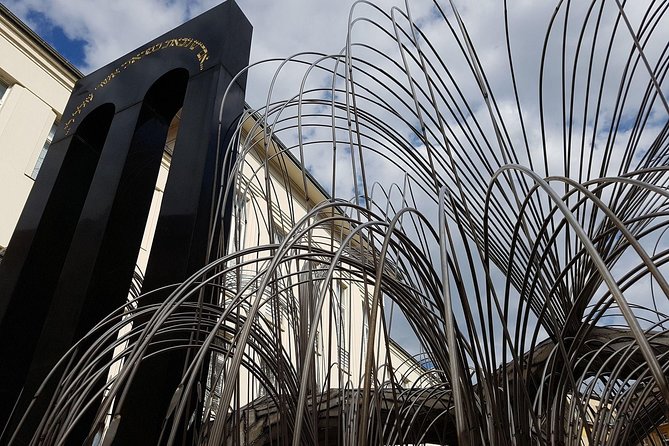
After the Dohány complex, you walk to the neighboring Ghetto Wall Memorial. Erected in 2014, it marks the location and memory of the former Budapest ghetto.
This stop helps connect the grand synagogue to the more confined reality that followed. The Dohány complex can suggest the confidence and scale of Jewish Budapest before the war. The ghetto wall points toward the forced restrictions and physical separation imposed later.
The short distance between these locations is meaningful. You do not need a bus ride or a change of neighborhood to move from a major house of worship to a memorial connected with confinement. The route lets you see how closely these parts of the story sit beside one another.
I appreciate that the tour does not rush straight from the synagogue to the most famous Holocaust memorial. The ghetto wall creates a pause and gives you a better sense of the neighborhood’s changing role.
Other guided walks around Budapest:
- Budapest: Buda Castle Walk with Saint Stephen’s Hall
★ 4.5 · 3,012 reviews - Big Bus Budapest Hop-On Hop-Off Bus and Walking Tour
★ 3.5 · 2,206 reviews - Budapest: Buda Castle District Walking Tour
★ 4.6 · 2,108 reviews - Budapest City Landmarks Walking Tour in 2 Hours
★ 5.0 · 2,048 reviews
Passing the mikve and the Kazinczy Street Synagogue
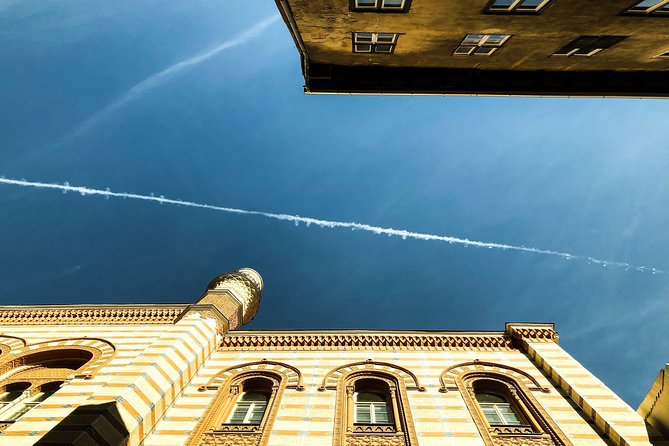
The route continues past a luxurious mikve, or Jewish ritual bath, and then to the exterior of the Art Nouveau Orthodox synagogue on Kazinczy Street. Since the synagogue is viewed from outside, you should not expect the same interior visit as at Dohány.
The mikve is an especially useful detail because it introduces Jewish ritual practice in a concrete way. It also reminds you that a neighborhood is made up of more than its most famous religious building. Daily religious life needed institutions for study, worship, ritual, charity, and community care.
Kazinczy Street adds the Orthodox side of the story. The Art Nouveau facade gives the stop a distinct visual character, while the guide explains how Orthodox Jewish life differed from the traditions represented elsewhere on the route.
The contrast with the Dohány Synagogue is part of the value. You see that Budapest’s Jewish community had internal debates and different approaches to religious practice. The tour treats those differences as part of the city’s story, not as a footnote.
Reading the Rumbach Street Synagogue from outside
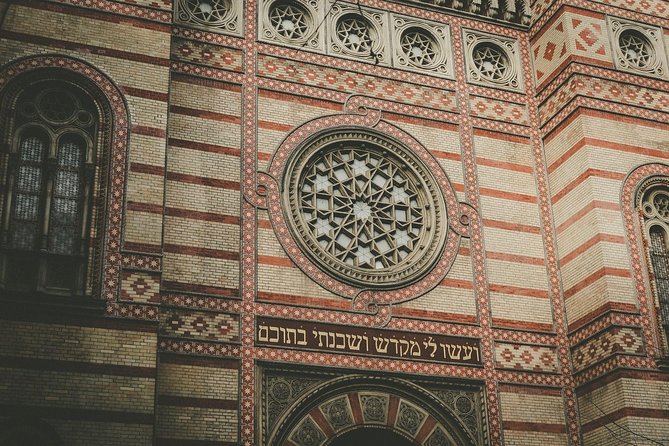
At Rumbach Street, the tour turns to the Status Quo Ante stream of Judaism. You observe the impressive facade of the synagogue from outside while your guide explains the group’s place within Budapest’s religious life.
Status Quo Ante communities occupied a position distinct from both the Neolog and Orthodox movements. You do not need to remember every label to benefit from the comparison. The important point is that Jewish Budapest contained several religious currents, each with its own institutions and outlook.
The exterior-only visit is a limitation, particularly if you are interested in synagogue interiors and architecture. Still, the stop works as part of the larger route because it lets you compare three important places of worship without turning the tour into a series of disconnected building visits.
If architecture is your main reason for booking, ask about the exact access included when you reserve. If social and religious history matters more, the exterior explanation should still provide useful context.
Ending at the Shoes on the Danube Bank
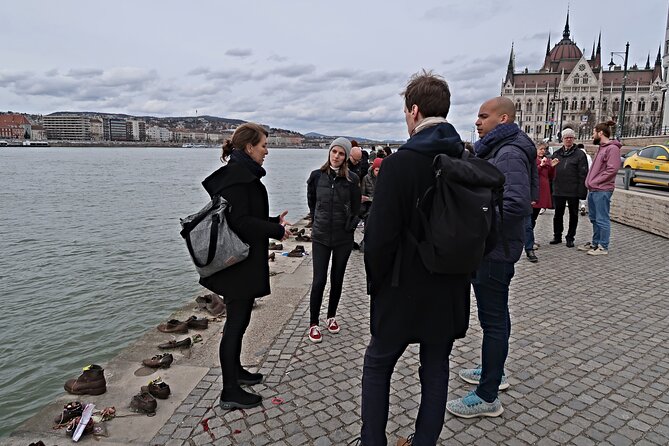
The tour concludes at the Shoes on the Danube Bank memorial, one of Budapest’s most affecting places. The iron shoes represent Jewish people who were murdered along the river during the Holocaust. The memorial is simple, direct, and difficult to look at casually.
This is a good place to end. After hearing about Jewish life, religious differences, and the former ghetto, you arrive at a memorial that asks you to stop and remember individual lives. The guide leaves room for reflection while connecting the site to the broader history of Budapest’s Jewish community.
The ending also brings the tour beyond the former Jewish quarter. You are no longer looking only at a neighborhood’s buildings. The Danube turns the city itself into part of the story.
The final discussion includes the renewal of Budapest’s Jewish community today. That does not erase the losses, but it prevents the tour from ending with Jewish life presented only as something that disappeared. I find that balance important. A good historical tour should name the destruction clearly while also showing that the story continues.
The guides make the difference
This experience is built around the guide. The available guides may be professors, doctoral students, historians, journalists, art critics, or published authors. That range suggests an academic approach, but the strongest guide is not simply the person with the most facts. The guide needs to make the facts understandable as you walk.
Orsolya has been praised for being thorough, thoughtful, and attentive to the group’s pace. She reportedly checked with the group before moving to the next stop, which is useful on a serious tour where you may want a moment to process what you have heard.
Endres has led a particularly detailed visit to the Great Synagogue and the surrounding area. He also helped a group pay respects to Holocaust victims by cleaning several stumbling stones, providing materials and taking part in the activity. That detail suggests a guide willing to respond to a meaningful request rather than simply follow a fixed script.
Another recent tour was described as highly personal, with a passionate historian who kept the discussion engaging. A small group or private booking should give you more room to ask questions, though the information provided does not promise a particular guide for every departure.
The tour is offered in English. If you care about a specific guide, ask the provider before booking rather than assuming a named guide will lead your departure.
Is $123 per person a fair price?
At $123 per person, this is not a budget walking tour. The Dohány Synagogue ticket, listed separately at 14,500 forints, adds to the total. You should compare the full cost with a standard synagogue admission and a general Jewish Quarter walk.
The value comes from the guide and the structure. You are not paying only to enter one building. You receive three hours with a historian, a guided visit through the Dohány complex, explanations of several Jewish traditions, and a route that ends at the Shoes on the Danube.
For a private booking or very small group, the price may make sense if you want to ask detailed questions or shape the pace. For a larger group, the cost may feel high unless Jewish Budapest is one of your main interests.
I would not choose it solely for sightseeing photographs. I would choose it if you want to understand what the buildings meant, how Jewish institutions differed, and how the community’s story changed before, during, and after WWII.
Timing, clothing, and practical details
The tour lasts three hours and starts at a time selected from the available options. The walk includes several stops, so wear comfortable shoes and plan to stay with the group between sites.
The route includes serious Holocaust memorials. Give yourself some quiet time after the tour if you can, especially since the final stop at the Shoes on the Danube may leave you wanting to sit and think rather than hurry to your next appointment.
Cover your shoulders and knees for the Dohány Synagogue. The entrance ticket is separate, and the stated price is 14,500 forints per person.
You can cancel up to 24 hours before the tour for a full refund, and the reserve-now, pay-later option keeps your plans flexible. Private and small-group formats are available.
Who should book this walking tour?
I recommend it most for first-time visitors who want a serious introduction to Jewish Budapest, people with an interest in European history, and anyone who prefers guided interpretation over self-guided sightseeing.
It is also a good fit for families with older children or teenagers who can engage with difficult history. The walking format gives the subject a physical setting, while the historian can answer questions that a museum label cannot.
I would think twice if your main goal is to see synagogue interiors. Only the Dohány Synagogue is clearly included as an interior visit, while Kazinczy and Rumbach are exterior stops. I would also consider a different activity if you want a relaxed, cheerful neighborhood walk.
Should you book it?
Book this tour if you want serious historical context, a guide with an academic background, and a route that links Jewish life before WWII with Budapest’s memorial sites today. The combination of the Dohány complex, ghetto wall, Kazinczy and Rumbach synagogues, and Shoes on the Danube gives you a fuller picture than any one stop can provide.
Skip it if the price feels too high once the synagogue ticket is added, or if you prefer to explore at your own pace. For everyone else, the guide-led format is the main reason to choose it. A strong guide can make the difference between seeing impressive buildings and understanding the people, beliefs, and losses connected to them.
FAQ
How long is the Jewish Budapest walking tour?
The tour lasts three hours.
What language is the tour offered in?
The tour is offered in English.
Where does the tour meet?
The stated meeting point is Kamara Café at Dohány utca 1/A. The exact starting location can depend on the option selected.
Is admission to the Dohány Synagogue included?
No. Individual admission to the Dohány Synagogue is listed separately at 14,500 forints.
What sites are included?
The route includes the area around Madách Imre Way, the Dohány Street Synagogue complex, the Kazinczy Street Synagogue exterior, the Ghetto Memorial Wall, the Rumbach Street Synagogue exterior, and the Shoes on the Danube Bank memorial.
What should I wear to the Dohány Synagogue?
Visitors are asked to cover their shoulders and knees.
Is the tour private or shared?
Private and small-group options are available.
Can I cancel the booking?
Yes. You can cancel up to 24 hours in advance for a full refund. You can also reserve now and pay later.
Just added around Budapest
- Budapest: City Bike Tour with Coffee Stop★ 5.0 · 37 reviews
- Walk to recent and aged spiritual sanctuaries near Budapest★ 5.0 · 5 reviews
- Budapest: Private Walking Tour with a Local Guide★ 3.6 · 6 reviews
- Budapest: Danube River Views Bike Ride★ 4.8 · 23 reviews
- From Budapest: Guided Tour of Eger with Wine Tasting★ 4.5 · 6 reviews
- Trash Art Museum: Hungary’s First Scrap Metal Exhibition★ 4.3 · 72 reviews
- True Crime Walking Tour in the Buda Castle district★ 5.0 · 26 reviews
- Budapest: 3-Hour Trabant Sightseeing Tour★ 4.7 · 28 reviews
Jewish Quarter Tours, compared.
Budapest Jewish Heritage Memorial Walking Tour & Synagogue Entry
Read our review →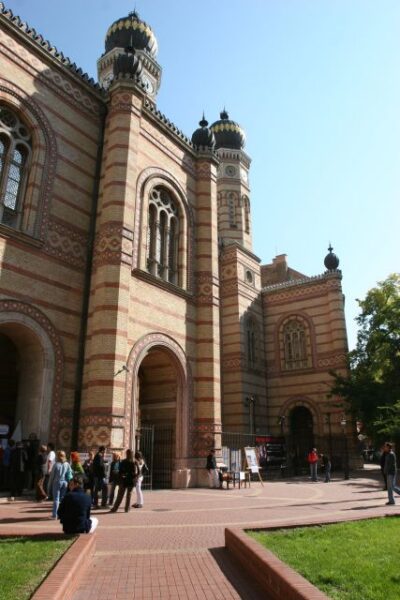
Jewish Heritage Guided Tour with Synagogue Ticket
Read our review →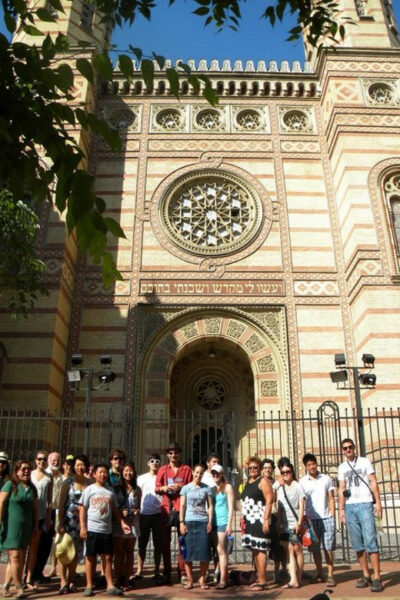
Past and Present of Budapest Jewish District Tour
Read our review →
Budapest Dohany Synagogue & Hungarian Jewish Museum & free extras
Read our review →
Jewish History Guided Walking Tour with Historian
Read our review →Browse the lists this tour appears in