
Reviewed · HISTORICAL TOURS
7 Days Balkan tour to historic Croatia and Bosnia Herzegovina
Dubrovnik’s stone walls, Plitvice’s silver-blue lakes, and Mostar’s famous bridge give this seven-day Balkan tour plenty of visual punch. You also get a useful sweep of the former Yugoslavia, from Zagreb and Split to Sarajevo, then return to Budapest through southern Hungary.
I like the route’s range: Croatia’s Adriatic cities pair well with Bosnia and Herzegovina’s Ottoman-era towns. I also like the practical setup, with coach transport, six breakfasts, a tour manager, and private hotel rooms included. The tradeoff is a busy schedule with long road days and only short visits at several major sites.
Key points
- Plitvice Lakes: Walk among 16 lakes, waterfalls, wooden paths, and forested hills during a guided visit.
- Dubrovnik: See the Old Town, Rector’s Palace, Franciscan Monastery, and famous defensive walls.
- Mostar and Blagaj: Combine the Old Bridge with a cliffside Dervish monastery and the medieval village of Počitelj.
- Sarajevo: Follow a city where Ottoman, Austro-Hungarian, religious, and 20th-century history meet.
- Small-group scale: The coach can carry a maximum of 30 people, though English and Chinese groups may be combined.
- Useful guide detail: Kenny has led the tour in fluent English and Mandarin, with local guides joining in several cities.
A seven-day route with a lot packed into it
This trip is best understood as a fast-moving introduction rather than a slow holiday. You start at Budapest-Keleti station at 8:30 a.m. and cover several countries, coastlines, old towns, Roman ruins, religious sites, and postwar cities before returning to Hungary.
The $1,160.11 price includes six nights in at least 3-star hotels, six breakfasts, air-conditioned coach transport, a professional driver, and an experienced tour manager. That is a fair package price for a route covering this much ground, especially since independent travel across multiple border crossings can quickly add up.
You should still budget for attraction tickets, lunches, dinners, drinks, personal expenses, and the required gratuity of €10 per person per day. The tour also excludes accommodation before the start and on the final night, unless you select the optional post-tour hotel in Budapest.
More of the past around Budapest:
- Budapest: Historic Cruise with Welcome Drink
★ 4.7 · 6,512 reviews - Budapest Historical Sightseeing – Free Walking Tour
★ 5.0 · 1,302 reviews - Buda Castle District Dark History, Legends and Vampire Night Tour
★ 4.5 · 1,240 reviews
Zagreb begins the journey with Gothic detail
Your first morning takes you from Budapest to Zagreb, Croatia’s capital. The city visit focuses on Zagreb Cathedral, Ban Josip Jelačić Square, and St. Mark’s Church, all within the historic center.
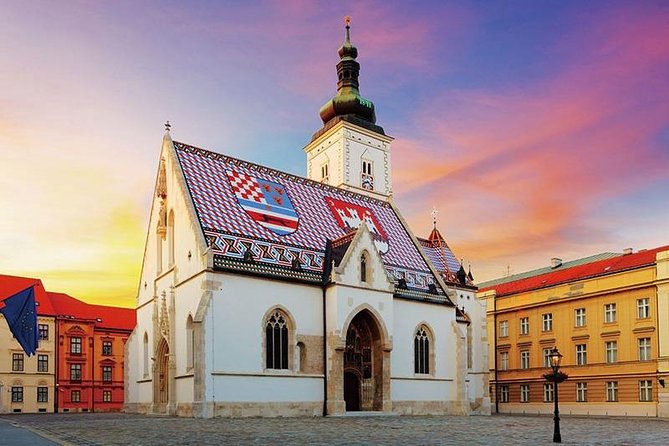
Ban Jelačić Square is the natural place to get your bearings. It is a broad central meeting point, and the surrounding streets lead toward the older Upper Town. St. Mark’s Church is the visual prize, with its colorful tiled roof showing the coats of arms of Zagreb and Croatia.
Zagreb Cathedral brings a different scale, with its tall Gothic form and carefully worked decoration. Admission is not included, so check with the tour manager before planning to go inside. The listed sightseeing time is short, about one hour at each stop, so expect an overview rather than a long museum visit.
You spend the night in Zagreb or a nearby town in a minimum 3-star hotel. Because the exact hotel is supplied only 24 to 48 hours before check-in, you should be prepared for a practical property outside the city center.
Plitvice Lakes is the natural highlight
Day two brings you to Plitvice Lakes National Park, one of the strongest stops on the route. The park links 16 lakes with waterfalls, wooden walkways, and hiking trails. Calcium carbonate in the water helps form travertine barriers, giving the lakes their unusual pale color and clear reflections.
I would treat this as a walking day, not just a photo stop. The park visit lasts about four hours, enough to see a good section of the paths, though not every corner. Comfortable shoes matter, and you should keep your camera ready because the water, trees, and falls change quickly as the path rises and bends.
The park admission is listed as included, unlike many of the city attractions later in the trip. That improves the value here, since Plitvice’s entry fee can be a noticeable extra on an independent visit.
You sleep in Zadar or nearby. The schedule gives you a useful contrast: Zagreb supplies urban architecture, while Plitvice gives you quiet woodland and water. The drawback is that this is still a coach tour, so your walking route and departure time are set by the group.
Zadar mixes medieval streets with modern sound
Day three starts in Zadar, an old coastal city with narrow lanes, religious buildings, and a strong medieval feel. The city’s waterfront adds a surprising modern touch through the Sea Organ and the Sun Salutation.
The Sea Organ turns waves into sound through pipes built beneath the waterfront steps. It is not a standard monument where you simply look and move on. Spend a few minutes listening, especially if the sea is active. Nearby, the Sun Salutation uses solar-powered lights to create a changing display after dark, though your daytime schedule may not allow you to see its full effect.
The visit is listed at about one hour, so you will have time to see the waterfront and central streets but not enough for a slow exploration. Admission to the city stop is free, while tickets for the Sea Organ attraction area are not listed as included.
A completely different kind of day out:
- Budapest: City Highlights Cruise with Welcome Drink
★ 4.6 · 35,610 reviews - Budapest: Unlimited Prosecco, Beer and Aperol Spritz Cruise
★ 4.8 · 25,310 reviews - Budapest: Széchenyi Spa Day Ticket with Optional Upgrades
★ 4.3 · 23,911 reviews - Budapest: Nighttime or Daytime Sightseeing Cruise
★ 4.2 · 21,062 reviews
Split places a Roman palace inside a living city
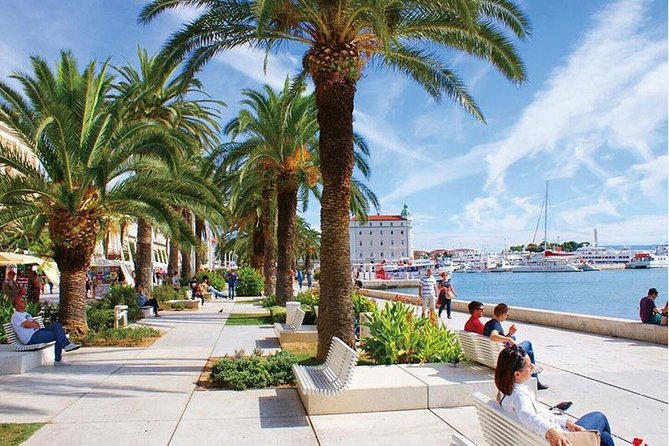
The road then continues to Split, Croatia’s second-largest city. Its main draw is Diocletian’s Palace, built in the fourth century and now woven into the modern center.
The Peristyle is the key place to focus on. This central palace court gives you the clearest sense of the Roman plan, but the real pleasure is seeing ancient stone used alongside shops, cafés, apartments, and everyday streets. Split is not a fenced-off ruin. It is an active city built through and around an imperial complex.
The listed stop lasts about an hour, which is enough for an introduction but not enough to inspect every palace passage or museum. If you enjoy Roman architecture, you may wish you had a longer stay. After Split, you overnight in Neum or nearby, placing you close to the Bosnia and Herzegovina border for the next part of the route.
Dubrovnik delivers the big postcard moment
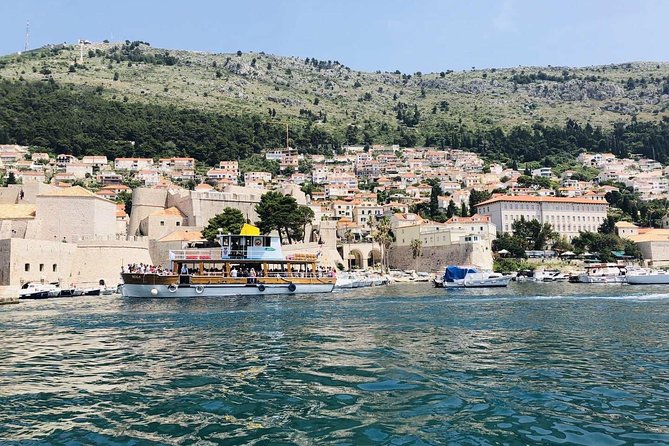
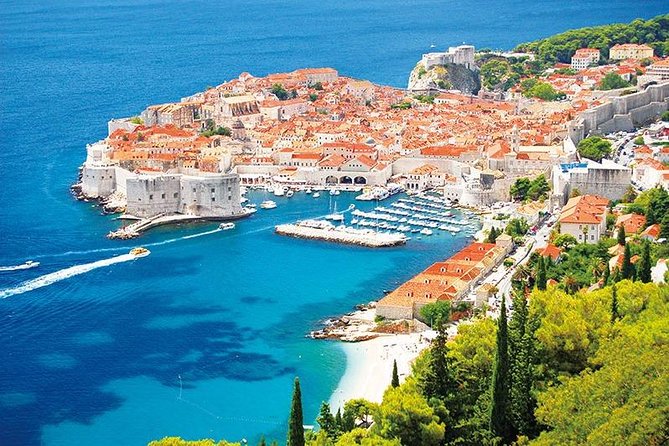
Day four is devoted to Dubrovnik, and this is likely to be the tour’s most anticipated stop. The Old Town sits behind heavy walls above the Adriatic, with polished stone streets, defensive towers, churches, and palaces packed into a compact area.
You see the Old Town, Rector’s Palace, Franciscan Church and Monastery, and the defensive structures. Rector’s Palace is especially useful for understanding how Dubrovnik’s former government operated. The Franciscan complex adds a quieter religious and architectural side, while the Old Town provides the broad visual experience.
The tour gives about two hours for Dubrovnik as a whole, with about one hour listed for several individual stops. That is enough to see the main sights and get a sense of the city, but the city walls and cable car are optional extras rather than included activities. If you want to walk the walls or ride up the mountain, confirm the available free time and ticket arrangements before the day begins.
Dubrovnik is also the point where crowds and prices can affect your experience, particularly in high season. The guided structure helps you find the main sights quickly, but it leaves little room for an unhurried café stop or a long museum visit.
Počitelj and Blagaj show a different side of Bosnia
Day five shifts inland and introduces Bosnia and Herzegovina. Počitelj is a stepped medieval fortress village, with stone buildings climbing the hillside. Its position and architecture make it feel very different from the polished Croatian coast.
You then continue to Blagaj, known for its Dervish Monastery beside a clear spring and a 200-meter cliff. The setting is one of the most unusual on the trip, combining water, rock, and religious architecture in a compact stop. Admission is listed as free for Blagaj, though specific interior tickets and optional activities should be checked locally.
These visits are each scheduled for about an hour. That works well for photographs and a guided introduction, but the uphill paths at Počitelj may require care. Bring water, wear shoes with a firm sole, and do not assume every stop will be flat or easy.
Mostar connects memory, architecture, and river views
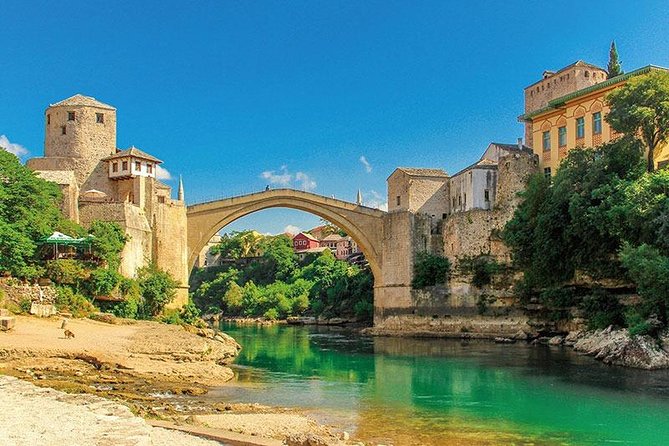
Mostar follows Blagaj and gives you time around the Old Bridge, the city’s best-known landmark. The bridge arches across the Neretva River and links the two sides of the historic center.
The Old Bridge area is more than a single photo stop. Look at the stone lanes, river views, and buildings around the bridge, then take a moment to consider how a crossing point can shape a city’s identity. Mostar is often presented as a scenic place, but its recent past is also part of what you see.
The bridge area is listed as a free stop, while admission to specific attractions is not included. The tour continues to Sarajevo for the night, probably in Sarajevo or a nearby town. Since Bosnia and Herzegovina uses the convertible mark, you should ask the tour manager about practical payment details before buying food or souvenirs.
Sarajevo gives the route its historical weight
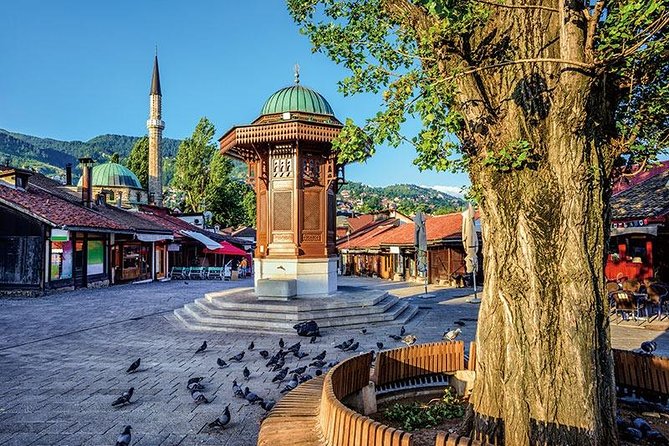
Day six brings a guided visit to Sarajevo, a city shaped by several faiths, empires, and political eras. The Old Town reflects its position between East and West, while newer buildings show the city’s rebuilding and change.
The Latin Bridge is the most famous historical stop. The assassination near the bridge in 1914 helped trigger the First World War, and the site gives that major event a clear physical setting. You can also see the Meeting of Cultures Line, marked on the ground where different architectural and cultural zones meet.
Sarajevo deserves more time than the listed one-hour stop allows. Still, a focused visit can give you a useful first look at the city’s religious mix, old streets, modern structures, and difficult 20th-century story. If Sarajevo interests you most, this tour may leave you wanting a separate return visit.
After the visit, you cross back into Croatia and spend the night in Vinkovci or nearby. Border delays are always possible, so do not schedule a tight flight or train connection from Budapest on the same afternoon.
Pécs closes the loop in southern Hungary
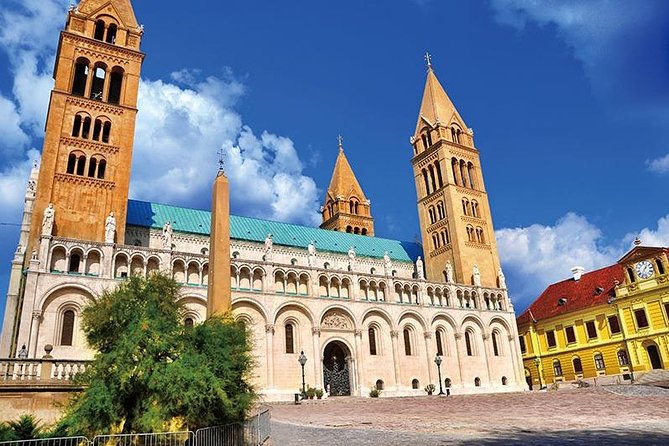
The final day returns you to Hungary with a stop in Pécs. The city lies between the Danube and Drava rivers and is known for its mild climate, museums, Turkish remains, music, opera, and ballet.
Pécs Cathedral rises above Szent István Square and gives the final stop a strong architectural focus. The city also offers some of Hungary’s best-preserved Turkish remains, though the schedule allows about an hour at each listed stop. Think of Pécs as a final taste, not a full city tour.
You return to Budapest in the afternoon and finish at the original meeting point. If you choose the post-tour hotel option, you can stay overnight in Budapest or nearby, which is useful if you have an early departure the next morning.
Hotels, coaches, and the group setup
The tour uses modern air-conditioned coaches, with a maximum group size of 30 people. That is small enough to keep boarding and head counts manageable, though it is not a private or intimate tour.
Hotels are at least 3-star, with private facilities and twin, double, or single rooms. A standard twin room is booked unless you request a double bed. A room can accommodate two adults and one child aged 2 to 11 without a separate bed, but groups of three adults should not expect a triple room.
The English service can involve a mixed English and Chinese-speaking group when numbers are low. One tour leader may speak both languages. Kenny, who has led this route in fluent English and Mandarin, is specifically associated with clear storytelling, humor, and careful attention to the group. Local guides also join in several cities, which adds useful place-based detail beyond what a single coach guide can cover.
You can bring one piece of luggage up to 30 kilograms and one small carry-on. Keep essentials, passports, medication, and valuables in the small bag, since hotel details arrive only shortly before each stay.
What the price really covers
At $1,160.11 per person, the tour offers good value if you want to see many major sites without arranging several hotels, border crossings, and long-distance transfers yourself. The included breakfasts and coach transport also make daily planning easier.
The price is less attractive if you prefer long stays, independent meals, museum time, or spontaneous changes. Many attraction tickets are not included, and the €10 daily gratuity adds €70 per person over seven days. You should also allow for lunches, dinners, drinks, optional cable car rides, city walls, and other paid entries.
The strongest value comes from the route itself. Plitvice, Dubrovnik, Mostar, Sarajevo, and Pécs would take careful planning to connect independently. Here, you trade flexibility for convenience.
Who should book this tour
I would recommend it to you if this is your first trip through the Balkans and you want a guided overview with hotels and transport handled for you. It suits people who enjoy changing scenery, historic centers, scenic walks, and a full schedule.
It is also a good fit for solo visitors who prefer company and a tour manager. The group can be international, and Kenny’s English and Mandarin service may be useful for mixed-language groups.
I would hesitate if you dislike early starts, coach travel, border crossings, or short visits. You should also think twice if Dubrovnik, Sarajevo, or Split is your main goal, since each receives only a limited amount of time. A slower, city-based trip would give you more depth.
The cancellation cutoff is three full days before the start time for a full refund. Passport details, nationality, date of birth, gender, and a contact number are required, and your passport must be valid for at least six months. You are responsible for checking visa, health, insurance, and entry rules for every country on the route.
Should you book it?
Book this tour if you want a high-value first look at Croatia and Bosnia and Herzegovina from a Budapest base, with the hard transport work arranged. Its best moments are the natural beauty of Plitvice, the drama of Dubrovnik, the river setting in Mostar, and Sarajevo’s layered past.
Skip it if you want a relaxed Adriatic holiday or several hours in every city. This is a brisk sampler, but it is a useful one, and the mix of coach convenience, local guides, and historic places makes the price reasonable for the right kind of visitor.
FAQ
Where does the tour start and finish?
It starts and ends at Budapest-Keleti station, Budapest, Kerepesi út 2-4, 1087 Hungary.
What time does the tour start?
The scheduled start time is 8:30 a.m.
How long does the tour last?
The tour lasts approximately seven days.
What accommodation is included?
Accommodation is included in comfortable hotels rated at least 3 stars, with private facilities and twin, double, or single rooms.
Are meals included?
Six breakfasts are included. Lunches, dinners, drinks, and personal expenses are not included.
Are attraction tickets included?
Some stops are listed as free, including Plitvice Lakes National Park, while many city attractions and optional activities require separate payment.
How much luggage can I bring?
You may bring one piece of luggage weighing up to 30 kilograms and one small hand-carry item such as a purse, backpack, or camera bag.
Can children join the tour?
Children under 18 must be accompanied by an adult. One twin room can accommodate two adults and one child aged 2 to 11 without a separate bed.
Just added around Budapest
- Walk to recent and aged spiritual sanctuaries near Budapest★ 5.0 · 5 reviews
- Budapest: Private Walking Tour with a Local Guide★ 3.6 · 6 reviews
- Budapest: City Bike Tour with Coffee Stop★ 5.0 · 37 reviews
- Budapest: Danube River Views Bike Ride★ 4.8 · 23 reviews
- From Budapest: Guided Tour of Eger with Wine Tasting★ 4.5 · 6 reviews
- Trash Art Museum: Hungary’s First Scrap Metal Exhibition★ 4.3 · 72 reviews
- Budapest: 3-Hour Trabant Sightseeing Tour★ 4.7 · 28 reviews
- True Crime Walking Tour in the Buda Castle district★ 5.0 · 26 reviews
Historical Tours, compared.

Budapest Historical Sightseeing – Free Walking Tour
Read our review →
Buda Castle District Dark History, Legends and Vampire Night Tour
Read our review →
BloodThirsty Hungary: Walking tour & Dark Historical Stories
Read our review →
Budapest Jewish Heritage Memorial Walking Tour & Synagogue Entry
Read our review →
Jewish Heritage Guided Tour with Synagogue Ticket
Read our review →
Budapest Historic Downtown Bicycle Tour in small groups
Read our review →
Historic Downtown ride on E-Bicycles Buda & Pest
Read our review →Browse the lists this tour appears in