
Reviewed · BUDA CASTLE & CASTLE DISTRICT
Buda Castle Walking Tour: A Kingdom of Many Nations
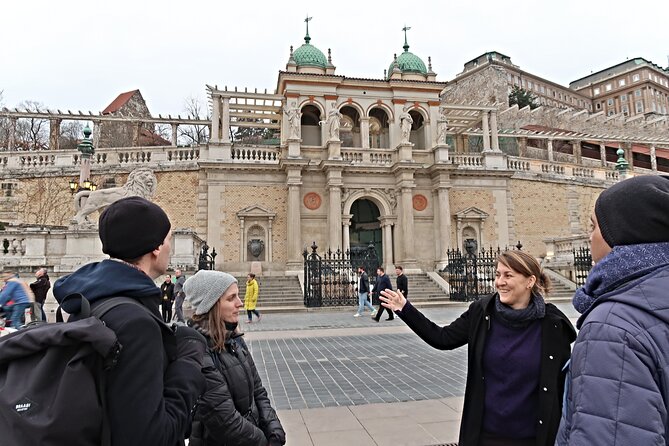
Castle Hill is not just a palace with a grand view. It is Budapest’s oldest quarter, a compact hilltop district where medieval streets, Baroque houses, royal buildings, wartime damage, and modern government offices sit side by side. This tour gives you the story that ties those pieces together.
I like the very small group, which can make a three-hour walk feel more like a conversation than a march. I also like the guide-led visit to Matthias Church, plus the wide Danube view from Fisherman’s Bastion. Guides such as Kata, Peter, Gregory, Veronica, and Marianna have been singled out for clear explanations and personal stories.
The main catch is simple: the tour price is $126.15 per person, but entrance fees for Matthias Church and Fisherman’s Bastion are extra. You also walk for the full three hours, and the title can mislead you a little: this is mainly a tour of the Castle District, not a tour inside a royal palace.
Key points to know before booking

- Small groups make a difference: Bookings are limited to six people, with a maximum of eight on the activity, allowing the guide to adjust the pace and answer questions.
- Castle Hill is a rebuilt historic district: Much of what you see today was restored after severe wartime damage, so the story includes reconstruction as well as medieval kings.
- Matthias Church costs extra: The church is one of the tour’s main interiors, but its admission ticket is not included.
- Fisherman’s Bastion brings the big views: Its terraces look across the Danube toward Pest, Margaret Island, and Gellért Hill.
- The guides are the heart of the experience: Kata, Peter, Gregory, Veronica, Marianna, Judith, Runa, and others have been praised for making Hungarian history easy to follow.
- You finish at Vienna Gate: The route ends in the northern part of the Castle District, with a view toward Óbuda and the site of Roman Aquincum.
Why Castle Hill is worth three hours
I recommend seeing Castle Hill with context rather than treating it as a quick photo stop. The district can look polished and quiet today, but its buildings reflect repeated conquest, royal ambition, religious change, war, and political rebuilding.
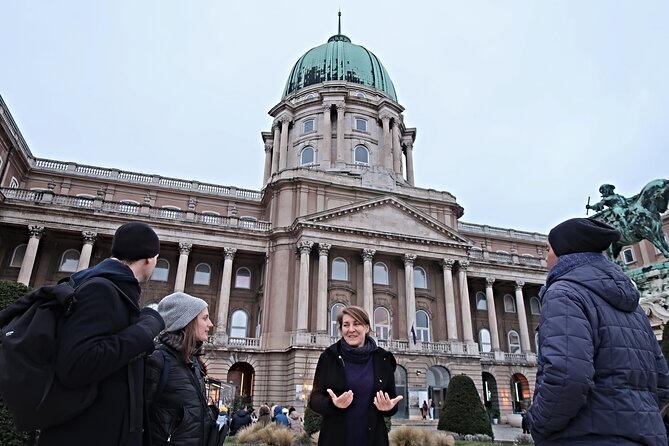
Your guide begins near Országház Street, at Budapest 1014, and leads you through the hilltop quarter on foot. The route covers the main royal and religious sights, but the real value is in the connections: why the fortress was built, how King Matthias turned Buda into a major court, how Ottoman rule changed the city, and why the palace you see today does not look medieval.
The small-group format matters here. A guide can stop for questions, point out details on façades, and adjust the discussion to your interests. One local guide even showed a family house connected to her grandmother, giving the district a personal link beyond dates and dynasties.
You should expect a steady walk over narrow and cobbled streets. Most people can take part, and the tour is near public transportation, but this is not a ride-through sightseeing outing. Wear shoes you can use comfortably for three hours.
More of the castle hill around Budapest:
- Budapest: Buda Castle Cave Tour
★ 4.7 · 5,677 reviews - Budapest: Buda Castle District Vampires and Myths Night Tour
★ 4.6 · 3,830 reviews - Budapest: Buda Castle Walk with Saint Stephen’s Hall
★ 4.5 · 3,012 reviews
The royal story begins at Buda Castle
The first major part of the walk focuses on the palace at the southern end of Castle Hill. It is massive, imposing, and much more complex than its appearance suggests.
King Béla IV built the first fortress here around 1250, after Mongol forces devastated the Hungarian kingdom. Later, King Matthias transformed Buda into one of Europe’s leading Renaissance courts in the late 15th century. That period is important because it connects the hill with Hungary’s strongest royal age.
The story then turns to the Ottoman period. Turkish pashas ruled much of Hungary for more than 150 years, changing the political and cultural life of the city. Habsburg rulers followed, bringing another layer of imperial power and construction.
Your guide also explains the building’s changing use. The palace was built, extended, damaged, burned, and rebuilt many times. Its current appearance is largely an eclectic postwar reconstruction, not a preserved medieval royal residence.
That distinction is useful. If you arrive expecting to wander through a perfectly preserved castle interior, you may be disappointed. If you want to understand how the site changed through centuries of conquest and rebuilding, the palace becomes far more interesting.
The palace portion includes a longer look at the complex, followed by a shorter explanation of its history and function. Since admission to the palace is not included, and the stated tour does not promise an interior palace visit, you should treat this section as an outdoor historical tour.
Sándor Palace and Hungary’s modern state
Near the royal complex, you see Sándor Palace, a Neoclassical building completed in 1806 for Count Vincent Sándor, an aristocrat and philosopher of the Austro-Hungarian period.
Since 2003, it has served as the official residence of Hungary’s president and the office of the president. That gives the walk a useful shift in focus. Castle Hill is not only an old royal quarter. It remains part of Hungary’s working political center.
The stop itself is brief, around five minutes, but it helps you read the district as a living part of Budapest. The royal palace recalls older power. Sándor Palace represents the modern state.
Matthias Church, the tour’s most decorated interior

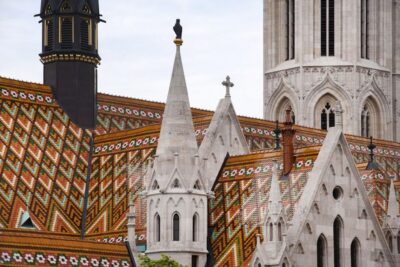
Matthias Church is one of the main reasons to choose this outing. Its colored roof immediately catches your eye, and its tall steeple rises above the surrounding streets.
The church is tied to the coronation of Hungarian kings, which gives it a central place in the country’s political and religious story. Yet the building you see is not a perfectly preserved medieval church. Much of its present appearance comes from a highly detailed Neo-Gothic reconstruction from the late 19th century.
That is not a flaw, but it is worth knowing before you arrive. The church is a reconstruction with a strong historical and artistic character, rather than an untouched medieval interior. Its patterned roof and decorated interior make it one of the most visually rewarding stops on the walk.
The tour allows about 20 minutes here. Your guide can explain the building’s role and point out details that are easy to miss when you visit alone. Admission is extra, so bring that cost into your budget. Several guides have also been able to take the group through the church when participants chose to pay the fee.
If you care about architecture, royal ceremonies, or Hungarian religious history, I would not skip the interior. If your budget is tight, you can still appreciate the outside, but you will lose one of the tour’s strongest visual moments.
Other guided walks around Budapest:
- Big Bus Budapest Hop-On Hop-Off Bus and Walking Tour
★ 3.5 · 2,206 reviews - Budapest: Buda Castle District Walking Tour
★ 4.6 · 2,108 reviews - Budapest City Landmarks Walking Tour in 2 Hours
★ 5.0 · 2,048 reviews - 3-Hour Orientation Walking Tour of Buda and Pest
★ 4.8 · 1,834 reviews
Fisherman’s Bastion delivers the classic Budapest view
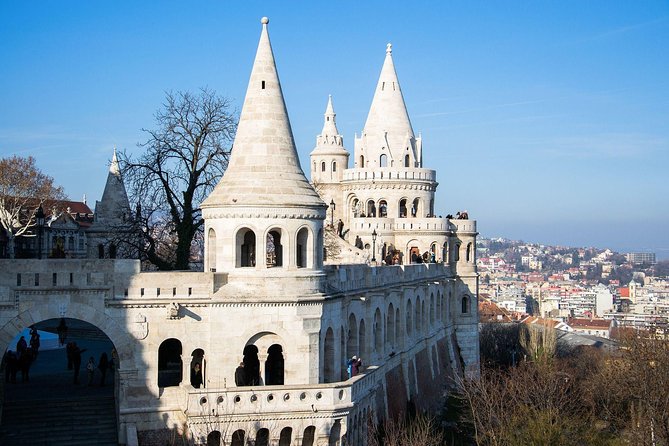
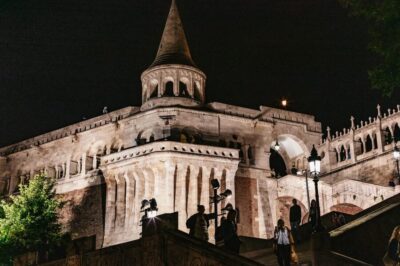
Fisherman’s Bastion is the tour’s great panorama stop. Built between 1895 and 1902, it uses Neo-Gothic and Neo-Romanesque forms to create an almost theatrical terrace above the city.
Its seven towers represent the seven Magyar tribes that settled in the Carpathian Basin at the end of the ninth century. That symbolism gives the structure more purpose than its fanciful appearance might suggest.
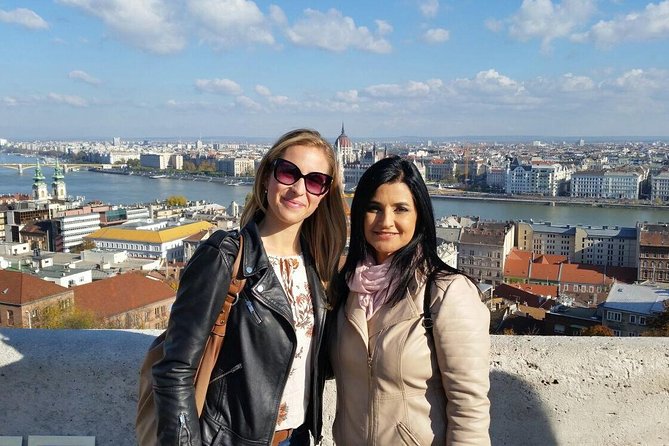
From the terraces, you can look across the Danube toward Pest, Margaret Island, and Gellért Hill. This is where the geography of Budapest becomes clear. You see how Buda rises on one side of the river while Pest spreads across the flatter eastern bank.
Admission to Fisherman’s Bastion is also extra. That matters because the tour price does not cover all the major paid stops. Still, the view is a strong part of the experience, especially if you want a guide to explain what you are looking at instead of simply taking photographs.
The Bastion can attract more people than the quieter streets nearby. Your guide helps you move beyond the photo platform and understand why the structure was designed as it was.
Vienna Gate closes the walk with an older horizon

The final stop is Vienna Gate, at the northern end of the district. From here, you can see toward Óbuda, or Old Buda, where the Romans founded the city known as Aquincum.
This is a satisfying end because it widens the story again. The walk began with medieval fortress building and royal power. It ends by pointing toward the Roman roots of the wider city.
The tour does not return you to the starting point. It ends in Budapest, near Vienna Gate, so plan your next move before you set out. The route’s one-way shape also means you see more of the district than you would on a short loop around the palace.
Guides are the biggest reason to book
The strongest feature of this experience is the guide. Names connected with especially well-received departures include Kata, Peter, Gregory, Veronica, Marianna, Judith, Runa, Henk, Susana, and others.
Kata has been praised for linking Hungarian history to present-day life and for keeping the walk energetic and friendly. Peter has been noted for adapting the discussion to the group and covering the district in detail. Marianna has shared personal memories of life under Soviet rule, adding a 20th-century perspective to a route that could otherwise focus too heavily on kings and churches.
Veronica is a good example of how the right guide can change the experience. The district includes a lot of rebuilt architecture, and a dry explanation could make it feel like a string of façades. Her approach turned the restoration story into a useful part of the walk.
Some guides also help with practical matters. Judith has assisted with Budapest public transportation, and another guide adjusted the start of the day so the group could eat lunch first. These touches are not guaranteed, but they show the value of a small group and a guide who pays attention to your needs.
You should not book this solely for a particular guide unless the booking system confirms that person. Guide assignments can change. But the consistent strength of the team makes the guide-led format a sensible choice.
Is $126.15 good value?

At $126.15 per person, this is not a cheap sightseeing walk. The price pays for a professional guide and a three-hour small-group experience, but it does not include hotel pickup, food, drinks, Matthias Church admission, Buda Castle admission, or Fisherman’s Bastion tickets.
I see the value in the group size. A large Castle District tour may give you the same basic route, but it is harder to ask questions or hear detailed stories. With no more than eight people, the guide can explain a family connection, pause for your interests, or adjust the pace.
The cost makes more sense if you want history and interpretation. You are paying for a guided reading of the district, not simply transportation between viewpoints. If you only want the church roof and Danube photographs, you can explore the area on your own for less.
For families with Hungarian roots, history fans, architecture students, and first-time visitors who want orientation, the price is easier to justify. It can also work well before a Danube river cruise, giving you a stronger grasp of Budapest before the city appears in shorter organized excursions.
The experience is recommended by 97 percent of participants and carries a 4.9 rating from 32 reviews. Those figures suggest a reliable experience, but your result will still depend on your interests, walking comfort, and guide assignment.
Who should book this Buda Castle walk?
Book it if you want a clear explanation of Hungary’s changing rulers and a close look at Castle Hill’s buildings. It is especially useful if you prefer small groups, ask questions, or want history connected to present-day Budapest.
I also recommend it if you have Hungarian family roots. Three hours of guided context can turn a collection of old streets into a place tied to national events, royal ceremonies, occupation, reconstruction, and family memory.
This may not be the best match if you want to tour palace interiors, avoid walking, or keep sightseeing costs very low. It is also not a complete Budapest city tour. One useful planning tip is to take a broader city tour first, then use this outing for a closer look at Buda.
Morning or afternoon departures vary by day. Check the available time when booking, and remember that cancellation is free if you cancel at least 24 hours before the local start time.
My recommendation
I would book this tour if you want the Castle District to make sense, not just look pretty. The route covers the essential sights, but the real benefit is the guide’s ability to explain why the hill has so many layers of royal, Ottoman, Habsburg, wartime, Soviet, and modern Hungarian history.
Choose it for the small group, the church interior, the Fisherman’s Bastion view, and the chance to ask questions. Skip it if you mainly want an inexpensive photo walk or an inside tour of the palace. For a first visit to Buda, this is a strong three-hour introduction, provided you budget separately for the paid sights.
FAQ
How long does the Buda Castle walking tour last?
The guided walk lasts approximately three hours.
Where does the tour begin?
The meeting point is Budapest, Országház u. 31, 1014 Hungary.
Where does the tour end?
The tour ends at Vienna Gate in the Castle District area of Budapest.
Is the tour offered in English?
Yes. The tour is offered in English.
How large is the group?
A booking can include a maximum of six people, and the activity has a maximum of eight travelers.
Are entrance tickets included?
No. Tickets for Buda Castle, Matthias Church, and Fisherman’s Bastion are not included in the tour price.
Does the tour include a visit inside the palace?
The tour discusses Buda Castle and its history, but the supplied details do not state that you enter the palace interior.
Is hotel pickup included?
No. Hotel pickup and drop-off are not included.
Can I cancel for a full refund?
Yes, if you cancel at least 24 hours before the experience start time. Cancellations made less than 24 hours in advance are not refunded, and changes within that period are not accepted.
Just added around Budapest
- Walk to recent and aged spiritual sanctuaries near Budapest★ 5.0 · 5 reviews
- Budapest: Private Walking Tour with a Local Guide★ 3.6 · 6 reviews
- Budapest: City Bike Tour with Coffee Stop★ 5.0 · 37 reviews
- Budapest: Danube River Views Bike Ride★ 4.8 · 23 reviews
- From Budapest: Guided Tour of Eger with Wine Tasting★ 4.5 · 6 reviews
- Trash Art Museum: Hungary’s First Scrap Metal Exhibition★ 4.3 · 72 reviews
- True Crime Walking Tour in the Buda Castle district★ 5.0 · 26 reviews
- Budapest: 3-Hour Trabant Sightseeing Tour★ 4.7 · 28 reviews
Buda Castle & Castle District, compared.
Buda Castle District Vampires and Myths Night Tour
Read our review →

Buda Castle District Dark History, Legends and Vampire Night Tour
Read our review →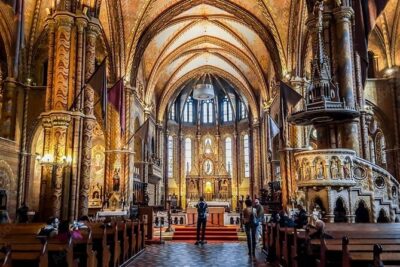

1.5 Hour Budapest Segway Tour – To The Castle Area
Read our review →Browse the lists this tour appears in