
Reviewed · WALKING TOURS
Budapest Castle Walk
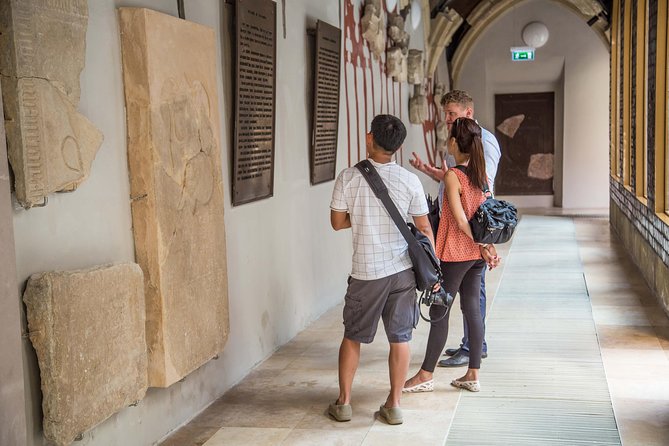
Budapest’s Buda Castle district is far more than a pretty hilltop with postcard views. This three-hour walk links medieval ruins, royal palaces, Ottoman memories, Jewish history, Habsburg rebuilding, and the destruction of the 1945 siege. I especially like the small maximum of eight people and the chance to enter Matthias Church, not simply admire its colorful roof from outside.
I also like the coffee break and the way the route reaches quieter courtyards, gardens, statues, and former Jewish sites that are easy to miss on your own. The main drawback is the price: at $125 per person, this is a premium walking tour, and the schedule can stretch beyond three hours if you linger. Check the 3:00 pm start time carefully, since one booking problem involved uncertainty about the tour hour and difficulty reaching the provider from abroad.
Key points to know before booking
- A compact group makes the history easier to follow: The standard small group has at least two and no more than eight people.
- The tour covers more than the main viewpoints: You’ll see courtyards, gardens, statues, old Jewish sites, medieval remains, and a WWII bunker.
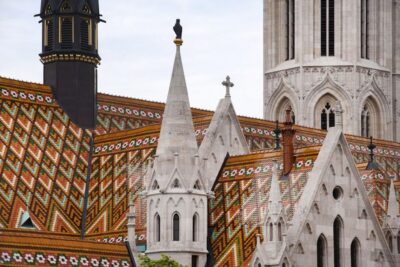
- Matthias Church admission is included: You can see the interior and its distinctive multi-colored tiled roof.
- The history spans seven centuries: Expect medieval royalty, Ottoman rule, Habsburg power, Jewish life, and the 1945 siege.
- The meeting point is below the castle district: You begin at the Zero Kilometre Stone at Clark Ádám tér and finish near Matthias Church.
- The $125 price pays for context and access: It makes the most sense if you want a guided historical walk rather than a quick photo stop.
Why Buda Castle deserves a guided walk
Buda Castle sits on a hill above the Danube, but its main attraction is not one single palace or church. It is the way different periods overlap in a compact old quarter.
The first royal residence appeared here in the mid-13th century, and Buda became home to Hungary’s royal court from the 1300s. By the 15th century, it had become an important European center with people from several national and religious backgrounds. The district later passed through Ottoman and Habsburg periods, then suffered enormous damage during World War II.
I find this sort of place much easier to understand with a guide. Without context, you may see Gothic details beside Baroque buildings and assume they belong to one period. Here, the rebuilding becomes part of the story. The palace and surrounding streets were destroyed and reconstructed more than once, so the present-day quarter is a record of both survival and reinterpretation.
The route also gives attention to the former Jewish community in Buda. You’ll see an old street and synagogue site connected with Jewish life on the hill. That adds useful depth to a district often presented only as the home of kings and grand churches.
Other guided walks around Budapest:
- Budapest: Buda Castle Walk with Saint Stephen’s Hall
★ 4.5 · 3,012 reviews - Big Bus Budapest Hop-On Hop-Off Bus and Walking Tour
★ 3.5 · 2,206 reviews - Budapest: Buda Castle District Walking Tour
★ 4.6 · 2,108 reviews
Starting at Clark Ádám tér and climbing into the old quarter

The meeting point is the Zero Kilometre Stone at Clark Ádám tér, near the Danube and the approach to the castle hill. This is a practical place to begin because it connects the lower city with Buda Castle.
From here, you move into the historic district on foot. The route follows streets shaped by the hill and by centuries of rebuilding. The walk is not simply a march from landmark to landmark. Your guide uses the streets, walls, ruins, and buildings to explain how Buda changed over time.
The meeting point matters for planning. You do not begin at Matthias Church or inside the castle district, so allow enough time to arrive at Clark Ádám tér by 3:00 pm. The tour ends near Matthias Church, which gives you a useful starting point for further sightseeing in the upper quarter.
Because this is a walking experience on cobbled streets and a hillside, comfortable shoes are sensible. The supplied information says most people can take part, but it does not provide detailed mobility guidance. If you have specific concerns, ask the provider before booking.
Fisherman’s Bastion and the first great views
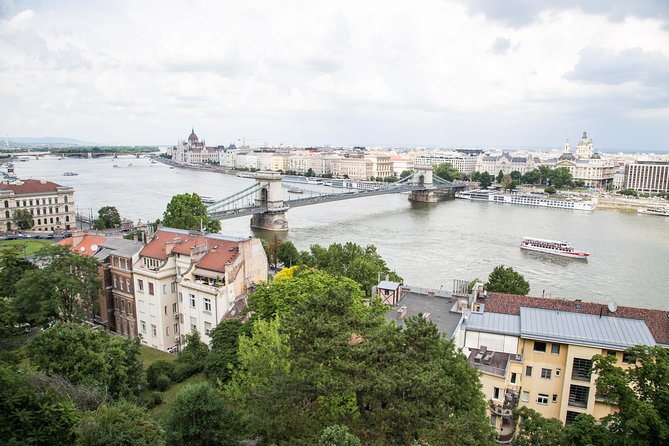
Fisherman’s Bastion is one of the tour’s headline stops, and it earns its place. From its terraces, you get broad views across the Danube and toward the Pest side of Budapest. It is also a strong point for understanding why this hill mattered militarily and politically.
The streets around the bastion follow the shape of the hill and have seen conflict since the first royal residence was built here in the 13th century. Your guide connects the views to the people who lived and ruled here, including Hungarian royalty, Habsburg leaders, and the Jewish population that once formed an important part of the neighborhood.
The listed stop lasts about 10 minutes and has no separate admission charge. That is enough for an introduction and photos, though it is not a long free period for exploring every terrace. If you want extended photography time, tell your guide at the beginning. The tour can run longer than three hours if you are not in a hurry, but the guide needs to know if you have a firm plan afterward.
Fisherman’s Bastion can feel like the most photogenic stop, but I would not treat it as the whole point of the outing. The views are easy to appreciate on your own. The useful part here is learning how the hill’s location, royal role, and defensive past fit together.
Matthias Church, from coronations to wartime damage
Matthias Church is the main interior visit. Admission is included, and you spend about 20 minutes learning about the church and seeing its interior.
The building is closely tied to Hungarian royalty. Many Hungarian kings were crowned here, making it a key place for understanding the political importance of Buda. Its colorful tiled roof is especially striking from outside, while the interior gives you a better sense of the church as a working historical monument rather than a simple viewpoint.
The church also helps explain the district’s complicated past. Buda became a European center in the 15th century, then passed through Ottoman and Habsburg rule. The church and its surroundings reflect those shifts, along with later destruction and rebuilding.
The tour brings World War II into the story here as well. You’ll hear about the heroes and villains associated with the period and the brutal Siege of Budapest, when German and Russian forces fought through these streets in 1945. Much of the neighborhood was demolished. That fact changes how you look at the polished façades and restored public spaces around the church.
Since Matthias Church admission is included, the $125 price has more substance than a simple exterior walking tour. The visit is still fairly short, so I would not book this experience expecting an extended museum-style examination of every architectural detail.
A completely different kind of day out:
- Budapest: City Highlights Cruise with Welcome Drink
★ 4.6 · 35,610 reviews - Budapest: Unlimited Prosecco, Beer and Aperol Spritz Cruise
★ 4.8 · 25,310 reviews - Budapest: Széchenyi Spa Day Ticket with Optional Upgrades
★ 4.3 · 23,911 reviews - Budapest: Nighttime or Daytime Sightseeing Cruise
★ 4.2 · 21,062 reviews
Royal Palace and the National Széchényi Library
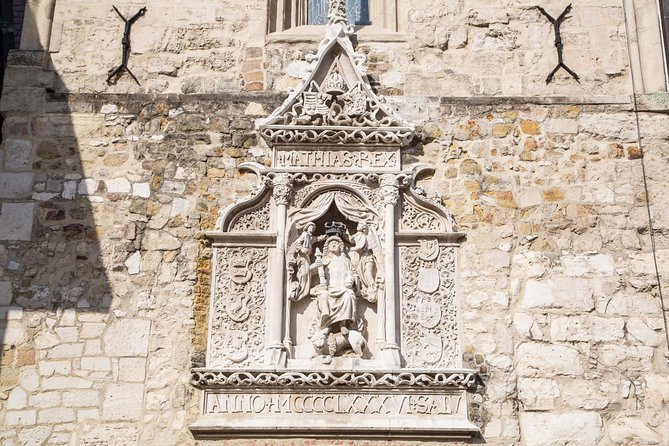
The Royal Palace is another major landmark, though this experience is primarily a walking tour rather than a museum package. You’ll see the palace area and learn how the royal court helped begin Buda’s long period of prosperity.
The National Széchényi Library appears as part of that story. The focus is on the role of the royal court and on how the palace district changed through repeated destruction and reconstruction. The stop is listed at about 10 minutes, with no separate admission.
One detail makes this section especially useful: no royals ever resided in the National Széchényi Library building itself, even though the arrival of the court helped shape the golden age of the area. A guide can separate the actual function of a building from the grand assumptions visitors may make when they see it beside the palace.
You should also keep expectations clear. The experience does not include admission to the museums, so you are not receiving a full interior tour of the Royal Palace or the library. If you want to visit museum collections, plan that separately and allow extra time after the walk.
Castle Garden and the Danube-side Várkert Bazaar
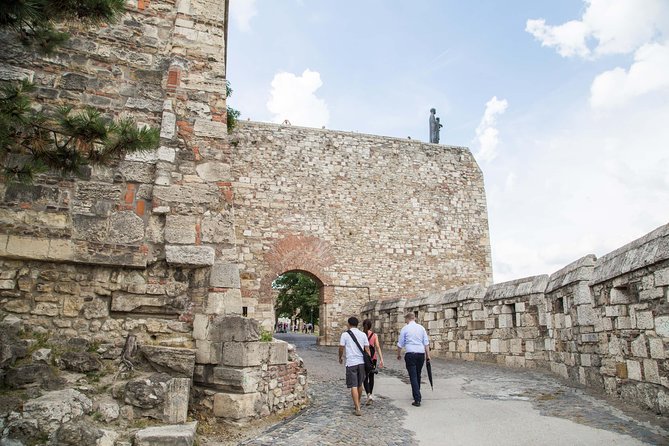
The route continues toward Castle Garden and the restored neo-Renaissance Várkert Bazaar along the Danube. This section gives the tour a different feel from the medieval streets above.
The Várkert Bazaar is a good place to see how Budapest has reused historic architecture. Its position below the palace connects the riverfront with the castle hill, and the restored setting offers another angle on the relationship between Buda and the Danube.
Castle Garden is listed as a roughly 10-minute stop. The surrounding district is still home to hundreds of ordinary residents, along with Hungary’s president, so this is not only a preserved monument zone. People live among the old buildings, public spaces, and historic sites.
I like this part because it keeps the tour from becoming a parade of royal names. You get a sense of the district as a real neighborhood, even though its past is unusually grand. It also gives you another chance for photographs and river views without requiring a separate sightseeing trip.
Jewish history, courtyards, gardens, and statues
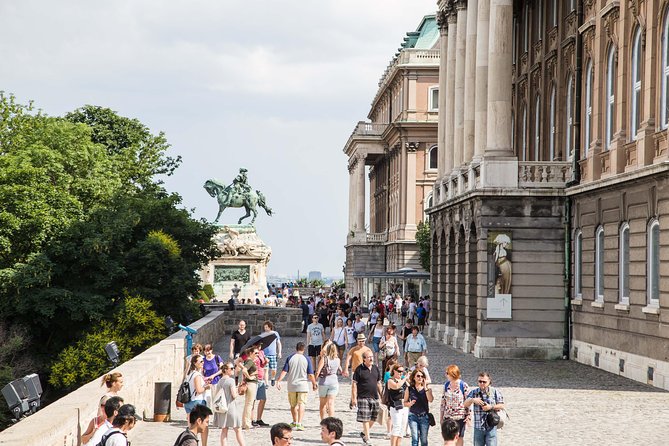
Some of the tour’s most worthwhile moments may be the places that do not dominate guidebooks. The route includes hidden gardens, courtyards, palaces, and statues, as well as an old street and synagogue site tied to Buda’s Jewish community.
These details matter because Buda Castle is often reduced to kings, churches, and panoramic photographs. The district was also a home for different nationalities and religious communities. Learning about its Jewish population makes the neighborhood feel less like a stage set and more like a place where ordinary life unfolded alongside court politics.
The guide’s role is important here. Courtyards and former community sites may not explain themselves, and some can be easy to pass without knowing what happened there. The small group size should make it easier to stop for questions without holding up a large crowd.
The supplied route does not assign a separate time block to each garden, courtyard, or Jewish site. Expect these places to be woven into the three-hour walk rather than treated as long standalone visits. That is ideal if you want a broad reading of the district, but less suitable if you prefer to spend a long time at one location.
The coffee break and the final WWII bunker visit

One coffee, tea, or another drink is included during the walk. This is a modest benefit, but it helps break up three hours on foot and gives you a natural moment to ask questions.
I would use the pause to clarify anything that has moved quickly, especially the succession of Ottoman, Habsburg, royal, and wartime chapters. The tour covers a lot of ground, and a short break can help the information settle.
The WWII bunker adds a sobering final note. The Siege of Budapest caused immense damage in the castle district, where German and Russian forces fought in the streets in 1945. Seeing a bunker in this setting links the broad wartime story to the physical reality of people sheltering and fighting in the neighborhood.
The bunker is not presented as a major museum visit, and the information does not specify a separate admission or extended time inside. Think of it as a focused historical stop within a walking route. Its value comes from showing how quickly a royal quarter could become a battlefield.
Is $125 a fair price for three hours?
At $125 per person, this is not a budget walk. You are paying for an English-speaking local guide, a small group of up to eight people, church admission, a drink, and a route that connects several periods rather than simply pointing out monuments.
The price makes the most sense if you value explanation. You could see Fisherman’s Bastion, the Royal Palace exterior, Castle Garden, and parts of the old quarter without paying for a tour. You could also visit Matthias Church separately. What you cannot easily reproduce is the single narrative joining medieval royalty, Jewish life, Ottoman rule, Habsburg influence, repeated reconstruction, and the 1945 siege.
The standard group requires at least two people and allows no more than eight. Larger groups can select a group option for at least eight people, while a private option can be customized. A small group is likely the best balance for most people. The private format costs more, but it may help if you need a tailored pace or want to focus on one subject.
The tour has a 4.3 rating from three submitted ratings, which is too small a sample to treat as a firm measure of quality. The one detailed complaint available concerned uncertainty about the start time and difficulty reaching the provider from abroad. I would save the confirmation and verify the 3:00 pm meeting time before your Budapest day begins.
Who should book this Buda Castle walk?
I would recommend it to a first-time Budapest visitor who wants the castle district explained in one well-organized outing. It suits anyone interested in political history, religious buildings, Jewish heritage, World War II, and architecture that changed through repeated rebuilding.
It also fits people who prefer a small group. With no more than eight participants, you should have a better chance to hear the guide and ask questions than on a large city tour. The private option is worth considering if you want a customized route.
I would be more cautious if you want long, quiet visits inside museums. Museum admission is not included, and the walk keeps moving through several locations. I would also think twice if you have a tight evening schedule, since the tour can continue past three hours when the group is not rushing.
The experience is available year-round, and mobile tickets are supported. Free cancellation is available up to 24 hours before the 3:00 pm start, but changes or cancellations inside that window are not refunded. The minimum group requirement also matters: if too few people book, the provider may cancel and offer another option or a full refund.
Should you book the Budapest Castle Walk?
Book it if you want context more than a checklist. The strongest parts are the small group, the included Matthias Church entry, the Danube and city views, and the attention given to Jewish history and the wartime destruction of Buda.
At $125, I would not choose it simply for photographs. I would choose it because a guide can make the castle district’s layers easier to read, from the first royal residence to the Ottoman and Habsburg eras and the ruins left by World War II.
If you book, confirm the 3:00 pm start time, arrive at the Zero Kilometre Stone at Clark Ádám tér, wear shoes suited to cobbled streets, and tell the guide at the start if you must finish on time. For a first visit to Buda Castle, this is a focused and thoughtful way to get oriented before returning on your own for museums or a slower look around.
FAQ
How long is the Budapest Castle Walk?
The tour lasts about three hours. It may run longer if the group is not in a rush, so tell your guide at the beginning if you have plans afterward.
What time does the tour start?
The listed start time is 3:00 pm.
Where does the tour meet?
The meeting point is the Zero Kilometre Stone at Clark Ádám tér, 1013 Budapest.
Where does the tour finish?
The tour ends near Matthias Church at Mátyás Templom, Szentháromság tér 2, 1014 Budapest.
Is admission to Matthias Church included?
Yes. Entrance to Matthias Church is included.
Is a drink included?
Yes. The tour includes one coffee, tea, or another drink during the coffee break.
How large is the group?
The small-group option has a minimum of two people and a maximum of eight participants. Larger groups can choose the group option for at least eight people.
Is a private tour available?
Yes. A private tour option is available and can be customized.
Can I cancel for a full refund?
Yes, if you cancel at least 24 hours before the experience start time. Cancellations or changes made less than 24 hours before the start are not refunded.
Just added around Budapest
- Walk to recent and aged spiritual sanctuaries near Budapest★ 5.0 · 5 reviews
- Budapest: Private Walking Tour with a Local Guide★ 3.6 · 6 reviews
- Budapest: City Bike Tour with Coffee Stop★ 5.0 · 37 reviews
- Budapest: Danube River Views Bike Ride★ 4.8 · 23 reviews
- From Budapest: Guided Tour of Eger with Wine Tasting★ 4.5 · 6 reviews
- Trash Art Museum: Hungary’s First Scrap Metal Exhibition★ 4.3 · 72 reviews
- True Crime Walking Tour in the Buda Castle district★ 5.0 · 26 reviews
- Budapest: 3-Hour Trabant Sightseeing Tour★ 4.7 · 28 reviews
Walking Tours, compared.
3-Hour Orientation Walking Tour of Buda and Pest
Read our review →
Budapest Historical Sightseeing – Free Walking Tour
Read our review →
Budapest All in One Small Group Walking Tour with Strudel Stop
Read our review →
BloodThirsty Hungary: Walking tour & Dark Historical Stories
Read our review →

Browse the lists this tour appears in