Reviewed · TOURS IN BUDAPEST
Budapest: Guided Tour of the House of Music, Hungary
Budapest’s House of Music is less a box for concerts than a piece of the park shaped into a building. Its floating, leaf-like roof and round openings catch your eye before you even enter, while the glass walls pull City Park right up to the foyer. This one-hour tour shows you why the building looks unusual and how its form helps with light, sound, and public life.
I like the tour for two clear reasons: you get close to the building’s spiral staircase and exposed materials, and a guide explains ideas you might miss on a quick walk past. Dora has earned special praise for her warm, energetic presentations, and another guide, recognized by her white hair with colorful highlights, was remembered for her kindness and professionalism.
The main consideration is scope. The $13 ticket covers the guided architectural tour, but not the exhibitions, Sound Dome, or Creative Sound Space. If you want hands-on music displays, this is only part of a House of Music visit. If architecture is your main interest, the price is easy to justify.
Key points at a glance
- A roof built like a canopy: Thousands of leaf-like metal elements form the undulating cover and help shape light and sound.
- A Japanese-designed cultural building: Architect Sou Fujimoto conceived the House of Music as a continuation of City Park.
- An impressive spiral staircase: The staircase is one of the building’s most memorable interior details.
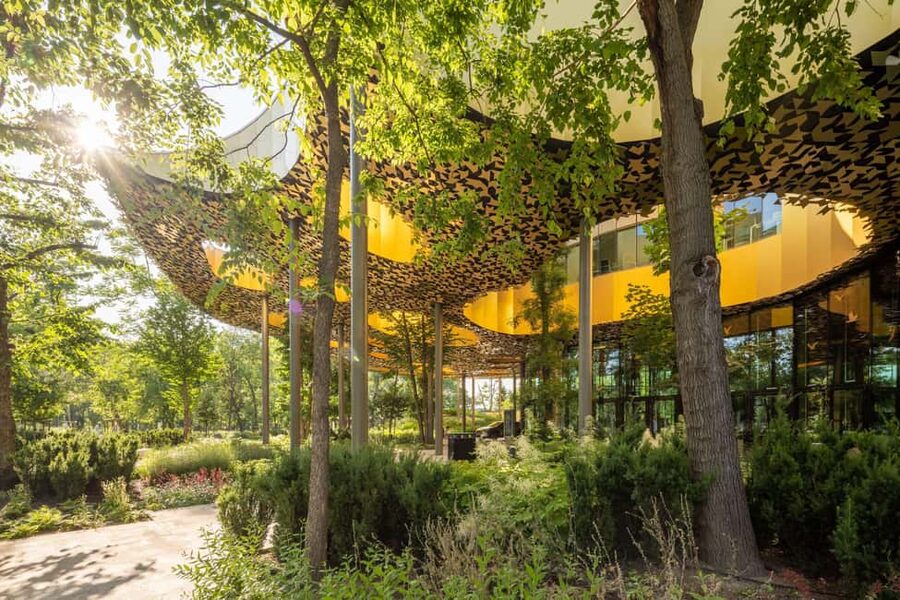
- A glass connection to the park: Large glass walls bring daylight and views of the trees into the public spaces.
- A focused one-hour visit: The tour is short, English-language, and centered on architecture rather than exhibitions.
- A low-cost introduction: At $13 per person, it offers a useful look at a major Budapest building without requiring a full museum ticket.
Why the House of Music deserves a closer look
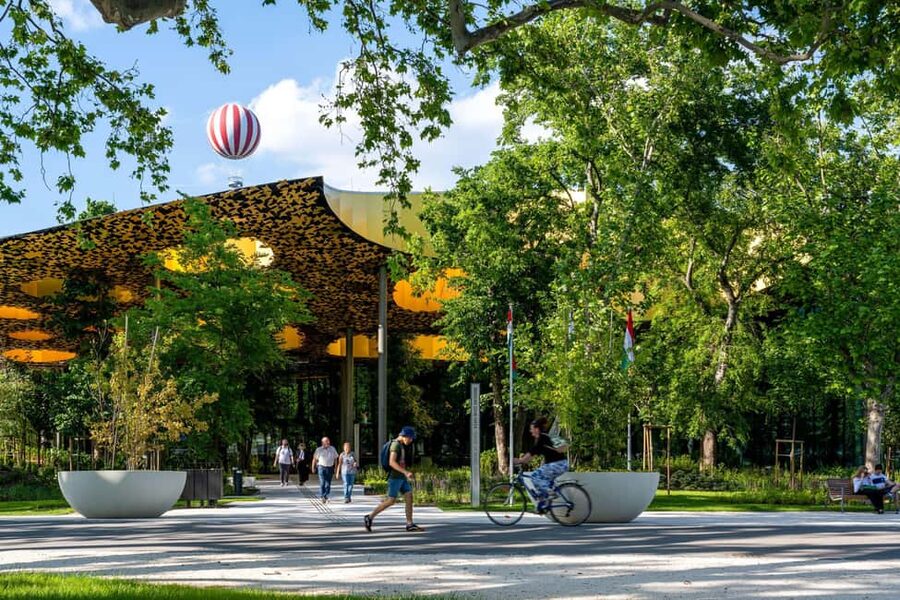
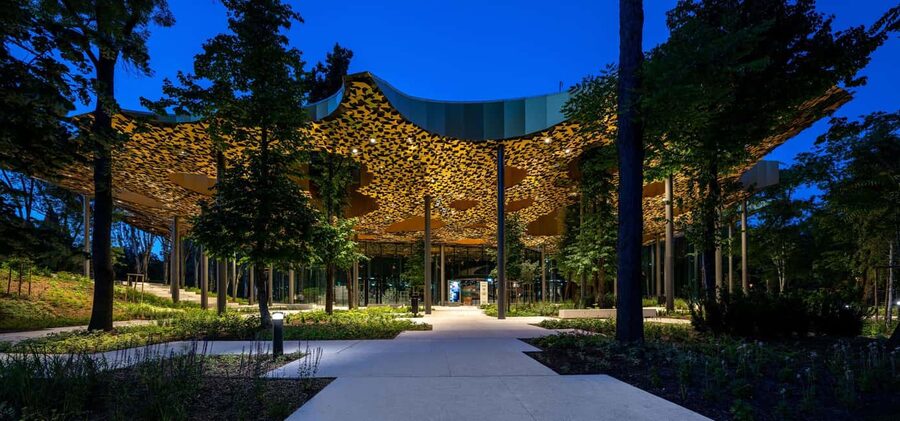
I find the House of Music most interesting from the outside. The roof appears to float above the building, rising and dipping in broad waves instead of forming a conventional flat or pitched top. Circular openings interrupt the canopy, allowing trees and sky to appear through it.
The surface is made from thousands of leaf-like metal elements. This gives the roof a woodland quality, fitting for its setting in Budapest’s City Park. It is not decoration added after the fact. The roof also helps manage natural light and contributes to the building’s acoustic design.
That connection between appearance and purpose is the heart of the tour. Your guide explains how the building’s shape, surfaces, and open areas support music while keeping the park present at every turn. You do not need an architecture degree to follow the explanation. The ideas are easiest to grasp when you are standing below the roof and looking up through its openings.
Sou Fujimoto, the Japanese architect behind the design, imagined the building as a continuation of the park rather than a hard boundary between trees and culture. The result is deliberately open. Glass, exposed concrete, timber details, and broad public areas give the building a different feel from a traditional enclosed concert hall.
Other guided tours around Budapest:
- Budapest: Parliament Building Entry Ticket and Audio Guide
★ 4.5 · 3,844 reviews - Budapest: Opera House Guided Tour
★ 4.6 · 1,533 reviews - Budapest Small-Group Guided Tour on MonsteRoller e-Scooter
★ 5.0 · 1,517 reviews
Starting inside the foyer
The tour begins inside the foyer. This is a sensible meeting point because the spacious entrance gives you room to look around before the guide starts pointing out details. The café area and open public spaces also help you understand how the building works as a social place, not just a venue for performances.
From here, the guide can show how the glass walls bring the park into the interior. Daylight reaches deep into the building, and the views help soften the concrete structure. You may find that the foyer is one of the best places to pause because several design ideas come together here: openness, natural light, timber, concrete, and the movement of people between levels.
The foyer is also useful if you arrive early. You begin at the stated meeting point rather than outside in an unclear location, and the tour ends there as well. Since the experience lasts one hour, you can fit it neatly into a day built around City Park without giving up half a morning or afternoon.
Looking up at the floating roof
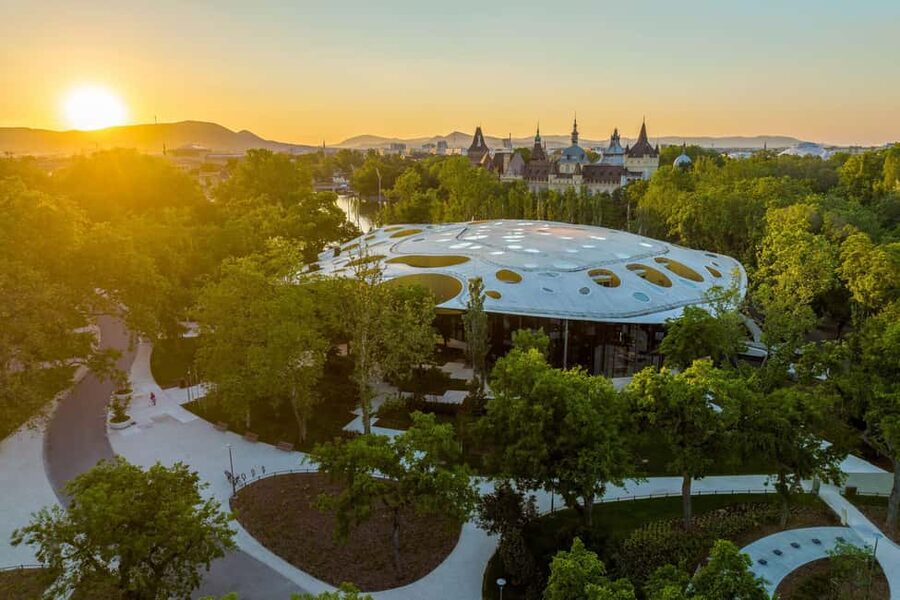
The exterior portion explains why the House of Music has become such an eye-catching addition to Budapest. The roof’s uneven profile gives the building motion, while the repeated leaf-like elements make it feel connected to the trees around it.
The circular openings are especially worth watching as you move around the structure. They break up the roof and create changing views of the sky and park. From one angle, the canopy feels dense and protective. From another, it opens like a series of windows overhead.
Your guide also explains the practical side. The roof helps with natural lighting and plays a role in the building’s acoustics. That matters because the House of Music needs to serve several purposes at once, including performance, education, public gathering, and quiet study.
I appreciate this part of the tour because it gives you a way to read the building. Instead of simply hearing that the roof is innovative, you learn what its unusual shape is doing. You can then notice the relationship between the openings, the daylight, and the surrounding trees for yourself.
Glass walls and City Park views
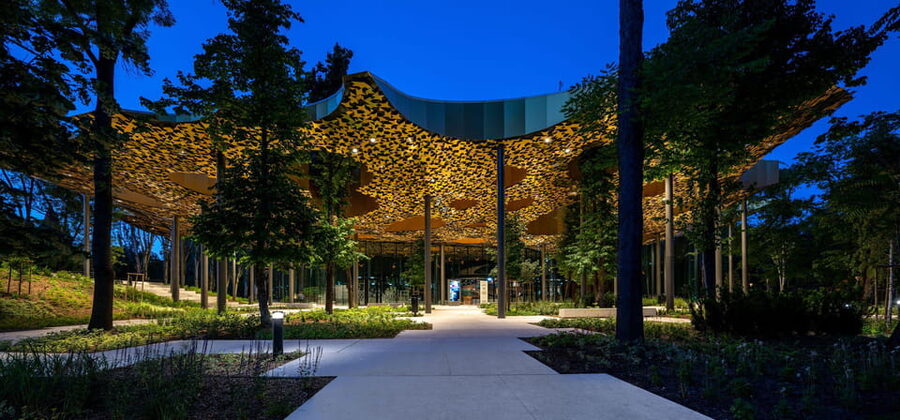
The House of Music makes a strong effort to keep the park visible. Its extensive glass walls create a direct visual link between the public rooms and the trees outside. You are not looking at a sealed museum interior with a few windows added for safety. The building is designed around the idea that nature should remain part of the experience.
The City Park setting adds much of the building’s appeal. The tour includes beautiful outdoor spaces and views across the park, so you get more than an interior architecture walk. The setting also helps explain Fujimoto’s approach. The building’s organic design would make less sense if it were surrounded by dense urban blocks, but among the trees, the roof and open edges feel more intentional.
You should keep your expectations practical. This is not advertised as a long park tour, and the one-hour schedule does not leave room for an extended walk through City Park. You will see and discuss the building’s relationship with its surroundings, then return to the foyer. Plan separate time if you want to explore more of the park.
A completely different kind of day out:
- Budapest: City Highlights Cruise with Welcome Drink
★ 4.6 · 35,610 reviews - Budapest: Unlimited Prosecco, Beer and Aperol Spritz Cruise
★ 4.8 · 25,310 reviews - Budapest: Széchenyi Spa Day Ticket with Optional Upgrades
★ 4.3 · 23,911 reviews - Budapest: Nighttime or Daytime Sightseeing Cruise
★ 4.2 · 21,062 reviews
The spiral staircase and interior structure
The spiral staircase is one of the strongest visual moments indoors. It is described as a work of art, and the guide uses it to show how movement through the building can be part of the architecture. Stairs are usually something you hurry through. Here, the curves and open views invite you to stop and look.
The interior combines exposed concrete with intricate wooden elements. Concrete gives the structure a clear, modern character, while the timber adds warmth. That balance keeps the building from feeling cold or overly technical.
As you move through the open levels, the guide points out how the building supports community use and music education. The spaces are not only for people who have come to hear a concert. They are also meant to welcome people who want to study, meet, browse, or learn about sound.
This is where the tour is more useful than a self-guided stroll. You can see the concrete and wood easily on your own, but the guide supplies the reason behind the choices. A good presentation also helps you notice how the building moves visitors between wide open areas, quieter corners, and views of the park.
Concert hall, library, archives, and public spaces
The guided tour includes a look at the concert hall, library and archives, outdoor spaces, and gift shop. These areas show the House of Music as a working cultural center with more than one function.
The concert hall is important even if you do not attend a performance during your visit. The guide explains how the form of the building and the choice of materials help with sound quality. The roof, interior surfaces, and room shapes all contribute to the acoustic plan.
You will not experience a live concert as part of this one-hour activity. That is worth noting before you book. The tour explains the design choices, but it cannot replace hearing music in the performance space.
The library and archives add another layer. They connect the building to research, learning, and preservation rather than treating music only as entertainment. The tour does not provide entry to the exhibitions, Sound Dome, or Creative Sound Space, but it still gives you a look at the building’s wider purpose.
The gift shop is included as part of the route. It may be a quick stop rather than a major feature, but it helps complete the visit and gives you a chance to browse after the architecture discussion. The foyer café also makes the entrance area practical for a pause before or after the tour.
How sound and sustainability shape the design
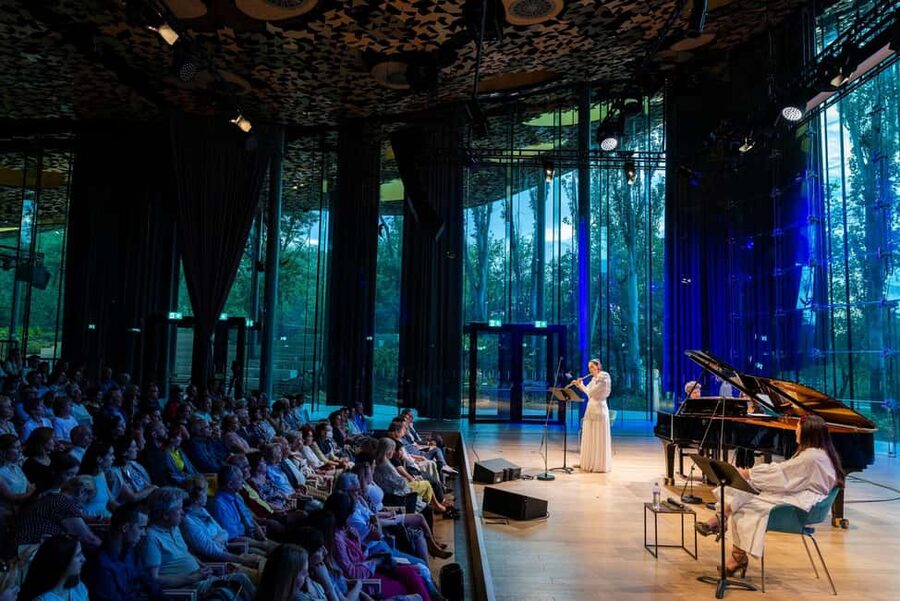
The House of Music is designed around sound, but its acoustic plan is not always obvious. A guide can point out how the building’s shape, materials, and roof structure help control sound in both performance spaces and public areas.
You will not hear a demonstration of every acoustic feature during the tour. Instead, you learn how the building was planned so that music remains central even in rooms that are not performance halls. That explanation adds value to the visible design. The curves and openings are not simply there to create a striking photograph.
The building also uses geothermal energy and rainwater harvesting. These features show that the project was planned with resource use in mind, alongside its artistic goals. The tour connects these systems to the larger idea of a building that works with its park setting rather than ignoring it.
I would not book this activity solely as a sustainability tour. Environmental systems are part of the explanation, not the whole focus. Still, if you like architecture that joins appearance, public use, sound, and practical engineering, this is a worthwhile part of the visit.
What the $13 price really gets you
At $13 per person, the tour is priced as an affordable introduction to one of Budapest’s newer cultural buildings. You get a live English-speaking guide for one hour and access to architectural areas including the concert hall, library and archives, foyer, outdoor spaces, and gift shop.
The strongest value comes from the explanation. You can walk around City Park and admire the roof for free, but you will not automatically know how the circular openings, glass walls, materials, acoustics, geothermal energy, and rainwater systems fit together. The guide turns a striking building into a readable one.
The price is less attractive if you mainly want exhibitions or interactive sound experiences. Those are not included, and the Sound Dome and Creative Sound Space require separate access. You should treat this tour as an architecture-focused introduction, not as a complete House of Music ticket.
For many visitors, that distinction is helpful. You can book this short tour for the building itself, then decide separately if the exhibitions suit your interests and schedule.
Guide quality and the feel of the visit
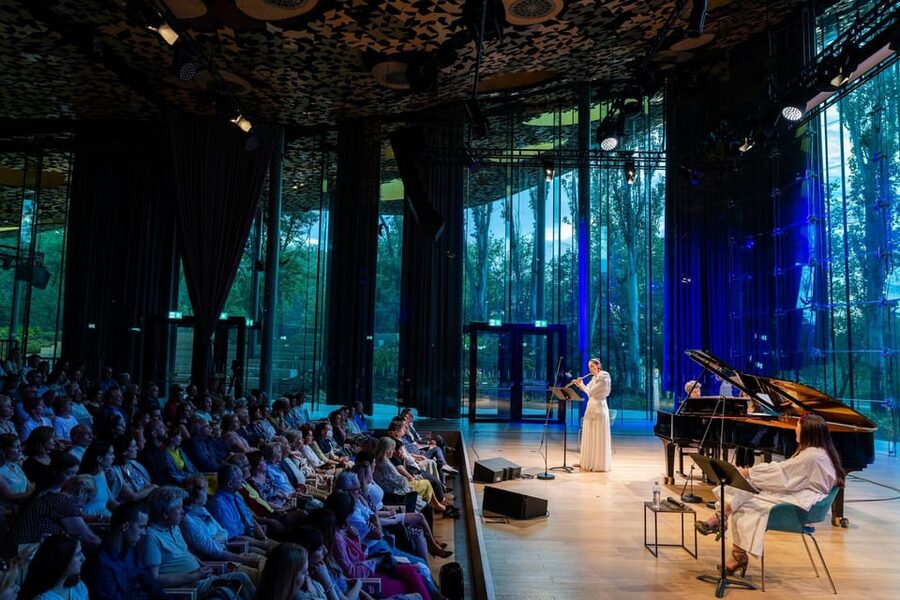
The guide can make a major difference during a short architectural tour. One hour is enough to explain the main ideas, but not enough for a slow, wandering visit. You want someone who can tell the story clearly and answer questions without turning the experience into a lecture.
Dora receives particularly strong praise for her detailed explanations, friendly manner, and positive energy. She also makes time for questions, which matters in a building with plenty of unusual features. Another guide was remembered for her white hair with colorful highlights, kindness, and professional approach.
You should expect the tour to be conducted in English. The format is guided rather than self-paced, so you will follow the group through the building and return to the foyer at the end. The activity is wheelchair accessible, which makes the one-hour route a practical option for many visitors.
Pets are not allowed, although assistance dogs are permitted. The activity is not suitable for children under 15, so families with younger children should choose another City Park activity.
Who should book this House of Music tour?
I would recommend it first to people who notice buildings. If a floating roof, unusual staircase, exposed concrete, or a clever use of glass can improve your day, this tour gives you plenty to study.
It also suits visitors who want a short cultural stop rather than another long museum visit. One hour is enough to understand the main design without exhausting your attention. The location in City Park makes it easy to pair with other plans in the area.
Music lovers may enjoy the explanations of acoustics and the building’s concert spaces, even though a performance is not included. People interested in sustainability will also find useful details in the discussion of geothermal energy and rainwater collection.
I would be more cautious if you want interactive exhibits, sound experiments, or a substantial museum collection during the same ticketed activity. Those experiences are not part of this tour. You may need separate admission, and the architectural route alone will not provide them.
Should you book it?
Book this tour if you want to understand why the House of Music looks the way it does. For $13, you get a focused introduction to the floating roof, glass walls, spiral staircase, acoustics, park connection, and public spaces, with an English-speaking guide to connect the pieces.
Skip it if you only want to see an exhibition or hear a concert. The tour does not include those experiences. But if you are already visiting City Park and enjoy thoughtful modern architecture, this is a well-priced way to spend an hour, especially with a guide such as Dora who can make the building’s ideas clear and memorable.
Free cancellation is available up to 24 hours before the activity, and you can reserve now while paying later. Check the available starting times before planning the rest of your day.
FAQ
Where does the House of Music tour begin?
The tour begins inside the foyer of the House of Music Hungary.
Where does the tour end?
The activity ends back at the foyer meeting point.
How long does the guided tour last?
The guided tour lasts one hour.
What language is the tour conducted in?
The tour is conducted in English with a live guide.
What parts of the building are included?
The tour includes the building’s architectural features, concert hall, library and archives, outdoor spaces, foyer, and gift shop.
Are the exhibitions included?
No. Entry to the exhibitions is not included.
Is the Sound Dome included?
No. Access to the Sound Dome is not included in this guided tour.
Is the Creative Sound Space included?
No. The Creative Sound Space is not included.
Is the tour wheelchair accessible?
Yes. The activity is wheelchair accessible.
Are children under 15 allowed to join?
The activity is not suitable for children under 15.
Are pets allowed?
Pets are not allowed, but assistance dogs are permitted.
Can I cancel for a refund?
Yes. You can cancel up to 24 hours in advance for a full refund.
Just added around Budapest
- Walk to recent and aged spiritual sanctuaries near Budapest★ 5.0 · 5 reviews
- Budapest: Private Walking Tour with a Local Guide★ 3.6 · 6 reviews
- Budapest: City Bike Tour with Coffee Stop★ 5.0 · 37 reviews
- Budapest: Danube River Views Bike Ride★ 4.8 · 23 reviews
- From Budapest: Guided Tour of Eger with Wine Tasting★ 4.5 · 6 reviews
- Trash Art Museum: Hungary’s First Scrap Metal Exhibition★ 4.3 · 72 reviews
- True Crime Walking Tour in the Buda Castle district★ 5.0 · 26 reviews
- Budapest: 3-Hour Trabant Sightseeing Tour★ 4.7 · 28 reviews
Tours in Budapest, compared.


Unlimited Prosecco, Beer and Aperol Spritz Cruise
Read our review →
Széchenyi Spa Day Ticket with Optional Upgrades
Read our review →


Budapest Danube Cruise and Dinner Options, Live Music and Dance
Read our review →