
Reviewed · TOURS IN BUDAPEST
Street Art and Alternative Tour in Budapest
Budapest’s street art is not just a collection of colorful walls. It is a running conversation about politics, culture, social change, and daily life. On this two-hour walk through District VII, guide ET points out the small stickers, boxes, sculptures, and painted walls that you could easily pass without noticing.
I like two things right away: the tour keeps its group to eight people, and it treats street art as something to interpret, not just photograph. ET also brings a local connection to the subject, with a clear interest in Budapest’s art scene and the forces shaping the neighborhood.
The main drawback is simple: you walk for most of the two hours, often on narrow streets, and the tour is not built around grand monuments or polished museum pieces. If you want a classic sightseeing route, this may feel too specialized. If you want a different way to read the city, it earns its place.
Key points at a glance
- Small-group format: The tour is limited to eight people, giving you a better chance to ask questions and discuss the art.
- A close look at District VII: You explore the streets around Budapest’s Jewish Quarter and ruin-bar district from a local art perspective.
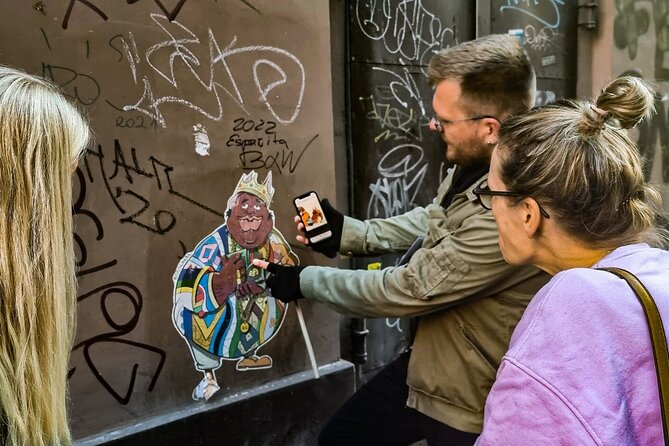
- More than murals: Expect stickers, smart-art images, bronze sculptures, painted walls, and other small works.
- Politics and social change: ET explains the ideas and events behind much of the work, rather than treating it as simple decoration.
- Useful first-day activity: The route ends at Szimpla Kert, the city’s oldest ruin bar, making it an easy introduction to the area.
- A real walking tour: Wear comfortable shoes and expect to move slowly while stopping often to look closely.
Reading Budapest through its street art
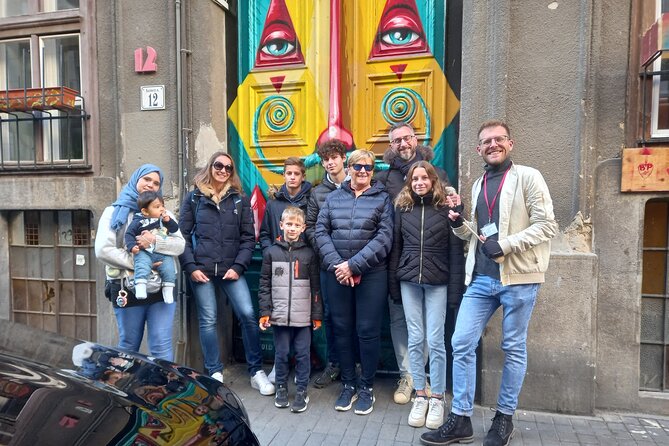
The best feature of this experience is its sense of attention. Budapest can reward a quick look, but street art asks you to slow down. A sticker on a utility box, a tiny figure fixed to a wall, or a political image partly covered by another work may tell you as much about the city as a formal monument.
ET’s approach is built around that pause. He points out different forms of street art and explains what they are trying to say. The subject is not limited to attractive murals. Some pieces may be funny, some critical, and some difficult to interpret at first glance.
That matters because the tour is less about collecting postcard views and more about learning how to look. You may leave with a habit of checking walls, signs, electrical boxes, and corners for details you would once have ignored.
The art also gives you a way to think about Budapest’s recent political and social life. The works can reflect public debate, changing neighborhoods, and the way artists respond to events around them. ET’s explanations place those works in a wider setting, so the walk becomes part art lesson and part city conversation.
Other street art walks around Budapest:
- Budapest: Street Art and Underground Movements Walking Tour
★ 5.0 · 238 reviews - Alternative Street Art Free Walking Tour of Budapest
★ 4.5 · 53 reviews - Budapest: Alternative Street Art & Jewish Tour
★ 4.8 · 49 reviews
Starting at Telep-Art Galéria
The tour begins at Telep-Art Galéria, at Madách Imre út 8. This is a useful meeting point because it places you close to the streets where the walk takes place, rather than sending you out toward a distant attraction before the tour even starts.
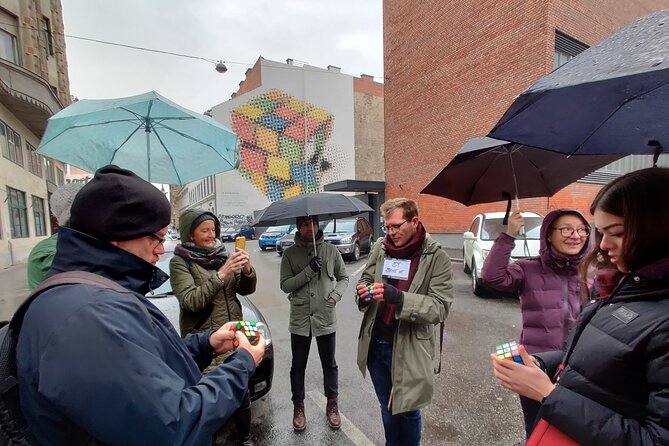
The early part of the route sets the tone. You move slowly through narrow streets while ET introduces the different kinds of work found in the area. The pace is deliberate. You are not rushing from one official sight to another, and that gives you time to notice smaller pieces.
The starting point also connects the walk to Budapest’s independent art scene. The tour is not presented as a standard city history walk with street art added as decoration. Art is the main subject, and the city’s changes are explained through that lens.
You should arrive ready to listen and look up, down, and sideways. Some of the most interesting pieces may not be large enough to catch your eye from across the street.
Murals, stickers, sculptures, and smart-art images
One useful feature of this tour is its variety. If you expect only large wall paintings, you may be surprised by how many forms street art can take.
You might see:
- Large-scale wall paintings
- Small stickers and repeated designs
- Bronze sculptures placed in public spaces
- Smart-art images
- Artwork on boxes and other overlooked surfaces
- Pieces with political or social messages
This range keeps the walk from becoming a simple mural checklist. A large painting is easy to spot, but a tiny sticker can require more explanation. ET helps you understand why both belong in the same discussion.
The art is not always about beauty. One especially useful lesson is that the message may matter more than the image. Some works may look plain or even unfinished until you understand the idea behind them. The tour gives you room to consider that rather than rushing on to the next colorful wall.
For families, this variety can work well because children can search for small details while adults listen to the political and cultural background. The guide describes the activity as suitable for all ages, and the relaxed pace allows different people to focus on different parts of the experience.
District VII beyond the standard Budapest route
District VII is one of Budapest’s best-known areas for nightlife and ruin bars, but this walk shows you a quieter and more thoughtful side of it. Instead of focusing only on drinking spots or famous buildings, you look at the visual messages placed around the neighborhood.
The route takes you along thin streets where you can see how public art fits into ordinary city life. A work may sit beside a doorway, on a wall, or on an object that most people would never consider an art surface. That setting is part of the experience. You are not viewing pieces in a gallery with labels and controlled lighting. You are seeing them where people live, work, walk, and argue about the city.
This also means the route can change. Street art is temporary. It may be painted over, removed, covered, or replaced. ET has said that tours can vary, and he may adjust the conversation to suit the group. That is a plus if you return to Budapest, since another walk may not be exactly the same.
The tradeoff is that you should not expect a fixed list of guaranteed works. The value lies in learning how to spot and discuss the art, not in checking off one famous mural after another.
A completely different kind of day out:
- Budapest: City Highlights Cruise with Welcome Drink
★ 4.6 · 35,610 reviews - Budapest: Unlimited Prosecco, Beer and Aperol Spritz Cruise
★ 4.8 · 25,310 reviews - Budapest: Széchenyi Spa Day Ticket with Optional Upgrades
★ 4.3 · 23,911 reviews - Budapest: Nighttime or Daytime Sightseeing Cruise
★ 4.2 · 21,062 reviews
ET’s approach to the tour
ET is the central reason this experience feels different from a self-guided stroll. He is involved in Budapest’s art scene and speaks with clear enthusiasm about the subject. That enthusiasm matters here because street art can be easy to overlook if you do not know the story behind it.
He explains the meaning of the works, points out details you might miss, and gives historical context when it helps. He also encourages questions and conversation rather than delivering a rigid speech. People with different levels of art knowledge can take part without needing to prepare beforehand.
The tour can become especially useful if you are interested in politics, creative movements, or the way artists respond to public events. ET has experience discussing European street artists and the wider ideas behind their work. He may also share resources and social media pages for people who want to keep following the art after the walk.
The tone is informal and interactive. You should expect a guide who wants you to look carefully and think aloud, not simply stand in one place while he recites dates.
Why the small group matters
A maximum of eight people is a strong feature for this kind of activity. Street art is easy to miss when a large crowd blocks a narrow pavement or when the guide has to repeat every point several times.
With a small group, you can ask why a particular image was placed there, compare interpretations, or bring up a work you notice yourself. The format also suits the subject because discussion is part of the experience. You are not only receiving information. You are deciding what you see and how you read it.
A small group can also create a more personal atmosphere. The tour is designed to be welcoming and interactive, and people may find themselves talking with others about art, politics, and their impressions of Budapest.
There is one practical point to keep in mind. Small tours may feel more conversational than anonymous. If you prefer to stay completely quiet and move at your own pace, a self-guided route may suit you better.
The walk to Szimpla Kert
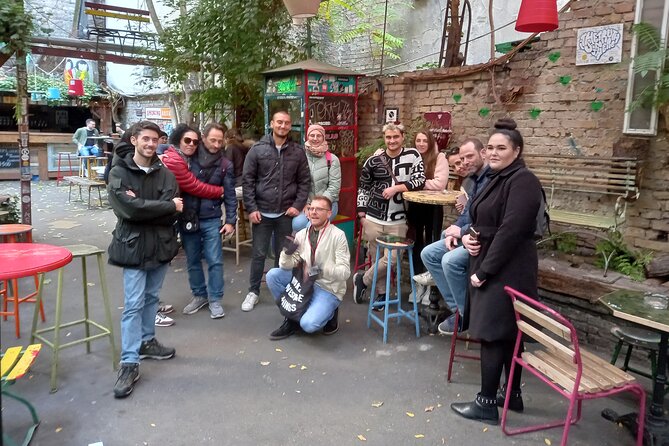
The tour ends at Szimpla Kert on Kazinczy Street, one of Budapest’s best-known ruin bars and the oldest ruin bar in the city. It is also one of the city’s symbols, so the ending gives you a natural next stop after the walk.
This finish works well because Szimpla Kert connects to the same alternative spirit as the art route. You end in a place associated with Budapest’s independent nightlife and unusual use of urban space, rather than at an ordinary transport stop.
You can treat the end as a chance to continue looking around the neighborhood, or simply use it as a clear landmark for finding your way afterward. The tour does not appear to include a meal or drink, so plan to pay separately if you want to stay at the ruin bar.
Ending at Szimpla Kert is also useful for first-time visitors. You finish in a central, recognizable part of District VII, with plenty of nearby streets to explore on your own.
Is $36.20 a fair price?
At $36.20 per person, this is not the cheapest way to spend two hours in Budapest. You can walk through District VII without paying anything, and you can find large murals on your own.
The value comes from the interpretation. A self-guided walk may show you the obvious painted walls, but it is less likely to explain the meaning of a small sticker, the political background of an image, or the reason a less attractive work matters. The guide turns scattered details into a connected story.
The price also covers a small-group experience rather than a large public tour. If the group reaches its limit of eight, you are paying for a better chance to interact with ET and see the art without being lost in a crowd.
I would consider it good value for anyone who is genuinely interested in street art, alternative culture, or modern Budapest. It is less compelling if you want a broad introduction to every major sight in the city. The tour has a narrow subject, and that is both its strength and its limit.
Timing, walking, and practical details
The experience lasts about two hours and is offered in English. You should wear shoes that are comfortable for walking and stopping often on city streets. The route is not described as difficult, but it is a walking tour, and there are no indications that seating is provided along the way.
The meeting point is near public transportation, which makes the start practical. Confirmation is provided when you book, and the activity allows service animals. Most people can participate, though anyone who finds extended walking uncomfortable should take the pace and street setting into account.
The tour is booked an average of 25 days ahead, so it is sensible to reserve early if your Budapest dates are fixed. You can cancel for a full refund up to 24 hours before the start time. Cancellations or changes made within 24 hours are not accepted for a refund.
Who should book this experience?
I would choose this tour if you enjoy noticing details, asking questions, and seeing a city through its less official forms of expression. It is especially well suited to artists, creative people, students of politics, and anyone who has already seen Budapest’s main sights and wants another angle.
It can also work well on your first day. The walk helps you get oriented in District VII, and the ending at Szimpla Kert gives you a clear place to continue exploring.
Families can take part, too, especially if children enjoy hunting for small images and unusual objects. Still, the political and cultural discussion may appeal more to older children and adults.
I would skip it if you want a bus tour, a major-monument route, or a polished gallery experience. Street art changes, the walk is informal, and some pieces may be more about ideas than visual beauty.
Should you book the Budapest street art tour?
Book it if you want Budapest to become a city you read, not just a city you photograph. ET brings energy, local art knowledge, and a willingness to discuss difficult or unexpected ideas. The limited group size gives the walk a personal feel, and the route ends at Szimpla Kert in the heart of District VII.
The best reason to go is that it may change how you walk through the rest of Budapest. After two hours of looking closely, a blank wall, sticker, box, or tiny sculpture may no longer seem blank or ordinary.
FAQ
How long is the Street Art and Alternative Tour in Budapest?
The tour lasts approximately two hours.
What language is the tour offered in?
The tour is offered in English.
Where does the tour start?
It starts at Telep-Art Galéria, Madách Imre út 8, 1075 Budapest, Hungary.
Where does the tour end?
It ends at Szimpla Kert, Kazinczy u. 14, 1075 Budapest, Hungary. Szimpla Kert is the oldest ruin bar in Budapest.
How many people can join the tour?
The group is limited to a maximum of eight people.
What kinds of street art will I see?
The tour can include murals, stickers, bronze sculptures, smart-art images, painted walls, and other small works placed around the streets.
Can I cancel the booking?
Yes. You can cancel up to 24 hours before the start time for a full refund. Cancellations or changes made less than 24 hours before the start time are not accepted for a refund.
Just added around Budapest
- Walk to recent and aged spiritual sanctuaries near Budapest★ 5.0 · 5 reviews
- Budapest: Private Walking Tour with a Local Guide★ 3.6 · 6 reviews
- Budapest: City Bike Tour with Coffee Stop★ 5.0 · 37 reviews
- Budapest: Danube River Views Bike Ride★ 4.8 · 23 reviews
- From Budapest: Guided Tour of Eger with Wine Tasting★ 4.5 · 6 reviews
- Trash Art Museum: Hungary’s First Scrap Metal Exhibition★ 4.3 · 72 reviews
- Budapest: 3-Hour Trabant Sightseeing Tour★ 4.7 · 28 reviews
- True Crime Walking Tour in the Buda Castle district★ 5.0 · 26 reviews
Tours in Budapest, compared.

Unlimited Prosecco, Beer and Aperol Spritz Cruise
Read our review →
Széchenyi Spa Day Ticket with Optional Upgrades
Read our review →


Budapest Danube Cruise and Dinner Options, Live Music and Dance
Read our review →
St. Stephen’s Basilica Entry with Terrace Option
Read our review →Browse the lists this tour appears in