
Reviewed · COMMUNISM HISTORY TOURS
Communist Budapest Walking Tour
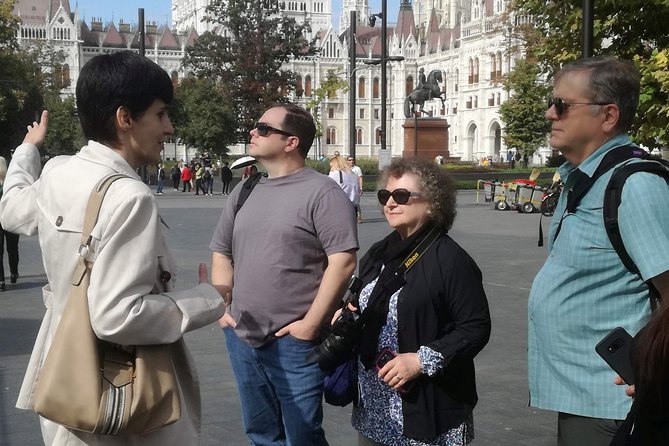
Budapest’s Communist past is easiest to understand when you see how politics shaped ordinary streets, homes, transport, and public squares. This three-hour tour links the 1956 uprising, Cold War symbols, 1970s apartment blocks, Socialist Realist statues, and the secret police headquarters into one clear route. The best feature is the connection between major events and daily life.
I like the mix of walking and public transport, especially the metro ride to a housing estate and the trolley bus trip along a parade route. I also like the guide profile: professors, doctoral students, historians, journalists, art critics, and authors lead these tours. The main drawback is that $123 per person is a serious price, and the tour may feel basic if you already know Hungary’s Communist period well.
Key points at a glance
- Start at Bem József Square: See where the first large demonstration of the 1956 uprising took place.
- Read the Cold War in four structures: Freedom Square brings the U.S. embassy, Soviet monument, Ronald Reagan statue, and atomic shelter entrance into one compact setting.
- Visit a 1970s housing estate: Understand why grey concrete apartments once represented comfort, status, and modern living.
- Use Budapest’s own transport: Metro and trolley bus rides help show how the city functioned, but you must buy the tickets separately.
- See Socialist Realist art at Puskás Stadium: Heroic workers, soldiers, and intellectuals point toward the future promised by the regime.
- Finish near the House of Terror: The former secret-service headquarters gives the tour a darker final note, with a piece of the Berlin Wall outside.
Why this tour works best through ordinary Budapest
A tour about Communism can easily turn into a parade of dates and political names. This one has a more useful angle. It shows you where public protest happened, how the state presented itself, and what life looked like inside a housing system that many people both disliked and depended on.
The phrase Goulash Communism describes Hungary’s softer version of Soviet-style rule after the harsh Stalinist years. Hungarians were allowed small freedoms in everyday life, but major political questions remained off limits. That trade shaped everything from public speech to apartment living.
I find the housing estate stop especially valuable. A row of grey blocks may look bleak now, but the tour explains why young families were delighted to receive one. Elevators, indoor conveniences, and newer construction offered a real improvement over many older Budapest buildings.
That contrast keeps the story from becoming a simple tale of villains and victims. The system was repressive, yet it also brought planned housing, modern infrastructure, and a degree of consumer comfort. Your guide’s job is to explain how those facts could exist at the same time.
More of the communist years around Budapest:
- Budapest: Budapest Retro Interactive Museum Ticket
★ 4.4 · 373 reviews - Budapest: Communist History Tour with House of Terror Option
★ 4.8 · 182 reviews - Communism in Hungary with a Historian
★ 5.0 · 70 reviews
Bem József Square and the first great protest
The meeting point is Bambi Eszpresszó at Frankel Leó út 2/4, in Budapest’s 1027 district. The tour begins at Bem József Square, an important starting place because the first large demonstration of the 1956 uprising was held here.
This is not just a square to photograph and leave behind. It gives your guide a place to explain how public anger gathered force and how a demonstration could become a national revolt. The location helps you picture the early stage of the uprising before the violence and political collapse spread across the city.
The nearby coffeehouse retains its original 1960s interior. That small detail matters. It gives you a physical glimpse of the everyday world behind the political story, a place where the period is visible in furnishings and atmosphere rather than only in monuments.
The coffeehouse stop also sets the tone for the tour. You are not only hearing about leaders, armies, and ideology. You are looking at the spaces where people met, talked, waited, and tried to live normal lives under an abnormal political system.
Kossuth Square and the memory of 1956
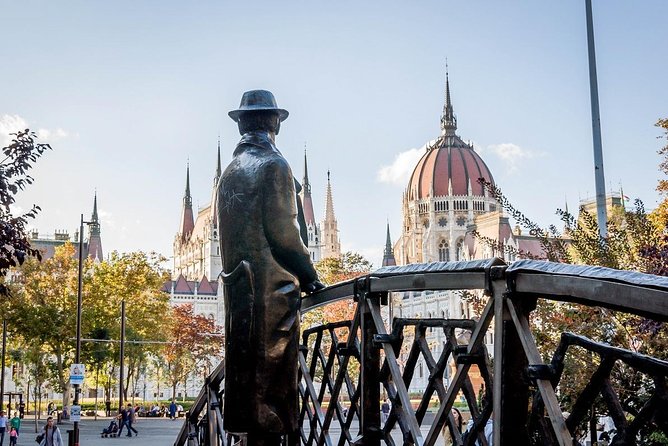
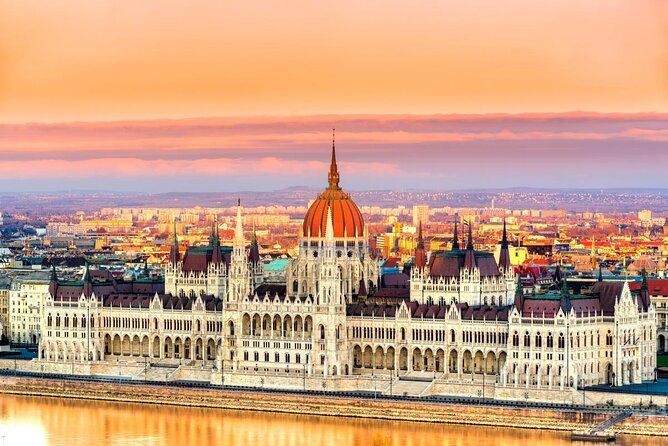
From Bem József Square, you take the metro to Kossuth Square, in front of Parliament. Public transport is part of the route rather than a minor convenience, and it lets you move between different parts of Budapest in the same way residents do.
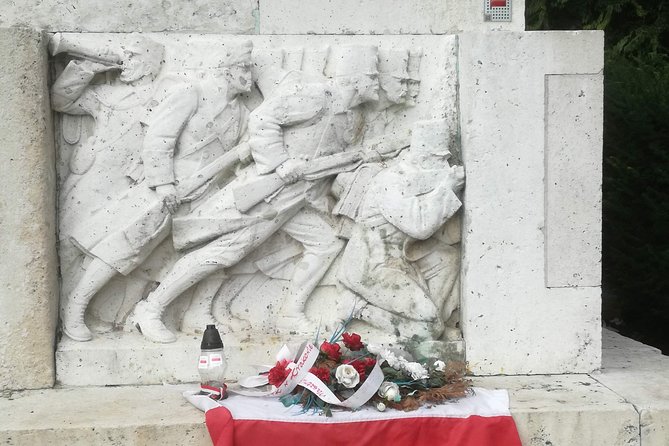
Kossuth Square was the site of crucial events during the 1956 revolution. Your guide points out monuments connected with the political and armed conflicts of that period. The square gives the uprising a grand civic setting, with Parliament as the backdrop.
I like this stop because it helps separate two parts of the story. Bem József Square shows the first large public demonstration. Kossuth Square shows how the crisis moved toward the heart of political power.
Do not expect a long museum visit here. The value comes from explanation at the site, with your guide connecting the square, the Parliament building, and the monuments to the upheaval of 1956. If you need lots of indoor exhibits or original documents, this tour is not designed for that.
Freedom Square’s four Cold War symbols
A short walk from Parliament brings you to Freedom Square. Here, four structures place Hungary’s Cold War position in one compact view:
- The U.S. embassy
- A monument to the Soviet army
- A statue of President Ronald Reagan
- The entrance to a secret atomic shelter
The arrangement is useful because it shows the tension between East and West without sending you across the city. The Soviet monument recalls the power that shaped Hungary’s postwar political system. The U.S. embassy represents the Western side of the Cold War. Reagan’s statue adds a later American political presence, while the atomic shelter entrance points to the fear of nuclear conflict.
You may find this one of the clearest stops on the tour because the symbols are so direct. Your guide can explain how a single square reflects occupation, alliance, propaganda, and the threat of nuclear war.
It is also a good place to ask questions. The tour is private or offered in small groups, and the guide is expected to adjust the discussion to the group’s background. One guide associated with this experience is Andras, who leads in a conversational style and can adapt the route when participants have already seen some of the standard sites.
Other guided walks around Budapest:
- Budapest: Buda Castle Walk with Saint Stephen’s Hall
★ 4.5 · 3,012 reviews - Big Bus Budapest Hop-On Hop-Off Bus and Walking Tour
★ 3.5 · 2,206 reviews - Budapest: Buda Castle District Walking Tour
★ 4.6 · 2,108 reviews - Budapest City Landmarks Walking Tour in 2 Hours
★ 5.0 · 2,048 reviews
The metro ride to a 1970s housing estate
The next metro ride takes you toward one of the 1970s housing estates at the edge of central Budapest. This is where the tour shifts from revolution and diplomacy to home life.
The blocks may look drab and grey today. Your guide explains why that appearance can be misleading. For a young Hungarian family, being awarded an apartment here could be wonderful news. Elevators and modern conveniences were not common in many older Budapest buildings, so a concrete tower could represent progress rather than failure.
This is one of the tour’s strongest ideas: a building can carry different meanings depending on when you see it. Today, you may notice the plain facades first. In the 1970s, a family might have noticed indoor comfort, a lift, and a stable home.
The stop also helps explain why Goulash Communism lasted as long as it did. Limited political freedom was paired with practical improvements for many citizens. That bargain did not erase repression, but it did shape how people judged the system in daily life.
The drawback is time. A three-hour tour covers a great deal, so you will not explore the housing estate in great architectural or social detail. Still, even a short visit adds an important layer that a standard political tour often misses.
Puskás Stadium and the art of the promised future
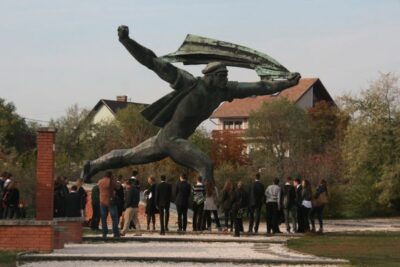
The route continues to the former People’s Stadium, now Puskás Soccer Stadium. It is one of the few places in Budapest where you can see typical Socialist Realist statues in their original public setting.
The figures show heroic workers, soldiers, and intellectuals. Their poses point toward a bright future, at least in the official story told by the state. The statues were not neutral decoration. They presented the kind of citizen the regime wanted to praise and the kind of society it claimed to be building.
This is a good stop for anyone interested in propaganda, architecture, or public art. You can see how politics entered the visual design of a city. Instead of placing political messaging only on posters or in speeches, the system built it into stone and concrete.
Bring a little patience here. The stadium area may appeal more to people who enjoy reading public symbols than to visitors seeking a dramatic landmark. Your guide’s explanation is what gives the statues meaning.
A Stalin-era trolley bus and the May Day boulevard
You then take a short ride on one of Stalin’s trolley buses to Dózsa György Street. This is one of the more unusual parts of the route because the vehicle itself becomes part of the story.
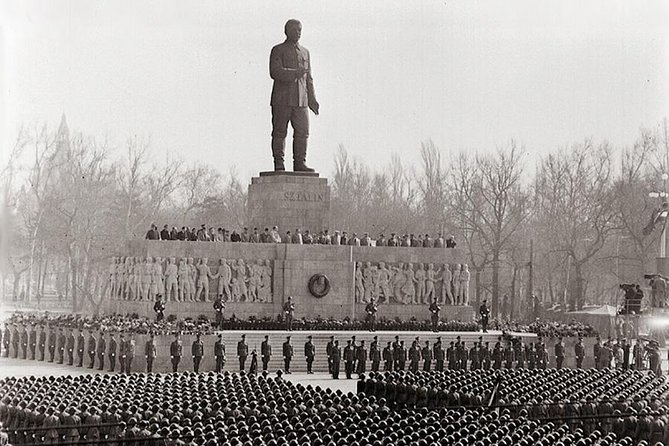
Dózsa György Street was a broad boulevard used for May Day parades. Your guide uses an iPad and old photographs to compare the street as it looks now with its appearance during the Stalinist period.
The old images are useful here. A present-day street can look ordinary until you see how it was arranged for mass marches, official ceremonies, and political display. The photographs help you notice scale, decorations, crowds, and the way public space was staged.
This is also where the tour can feel most like a moving history lesson. You are not simply told that parades happened. You travel along the route and compare the modern city with the controlled public image of the past.
Public transport tickets are not included, so plan to purchase the metro and tram or trolley bus tickets yourself. The tour description specifically excludes these fares. Ask about the exact tickets you need at the start if you are unsure.
The House of Terror and the final piece of the story
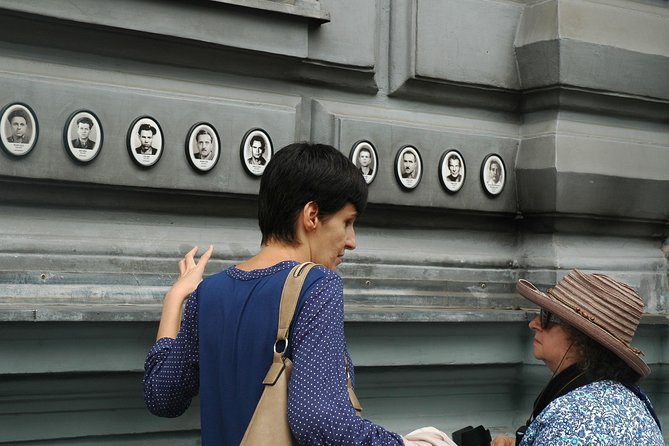
The tour ends around the House of Terror, located in the former headquarters of Hungary’s secret services. The museum commemorates the crimes of Communism, with special attention to the Stalinist years.
The building gives the final section a darker mood. Earlier stops have shown public protest, Cold War tension, housing, art, and parades. Here, you confront the machinery of state repression and the people who were targeted by it.
A slab of the Berlin Wall sits in front of the building. That piece of concrete ties Budapest to the wider collapse of Communist rule in Central and Eastern Europe.
The tour does not include entry to the museum, so you should think of this as an exterior stop and a historical explanation rather than a full museum visit. If the House of Terror interests you, allow separate time to go inside on your own. The walking tour can help you understand why the building matters before you visit.
The ending is effective because it returns the story to human cost. Housing and public improvements may explain why the regime gained some consent, but the secret police headquarters shows the limits of that bargain.
Guide quality and the level of history you can expect
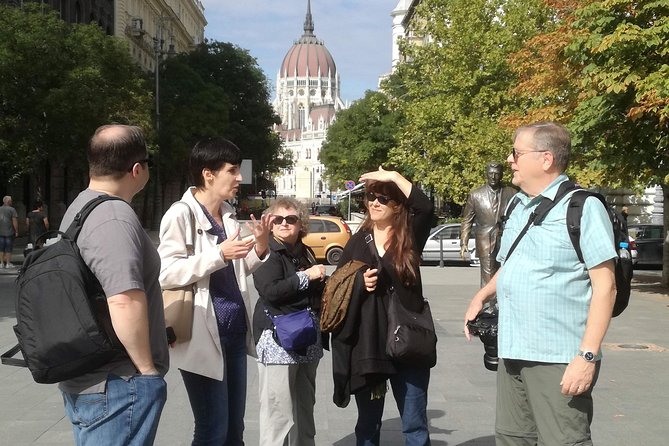
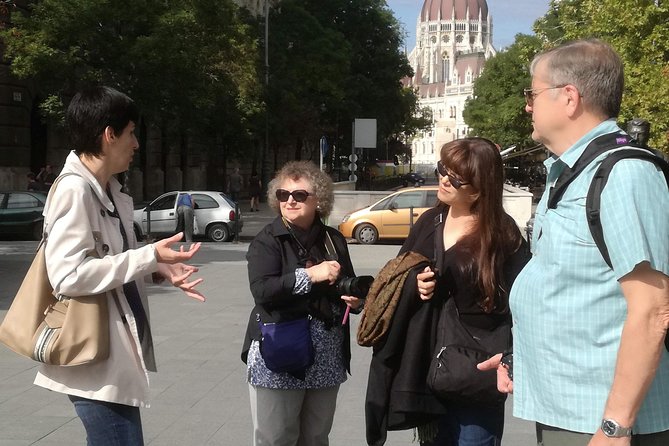
The guides come from academic and cultural fields, including professors, doctoral students, historians, journalists, art critics, and published authors. That range suggests a tour built around discussion rather than a fixed speech.
You should still set your expectations carefully. The strongest experience will likely come when you ask questions and explain what you already know. A guide can adjust the route and discussion for a private or small group, and the tour is conducted in English.
The available information about Andras describes a relaxed, conversational approach. If he is leading your departure, you may find the pace comfortable and the discussion adaptable. Other guides may have different specialties, so the exact feel can vary.
This tour is best for someone with little or moderate knowledge of Hungary between the end of World War II and 1989. If you already know the 1956 revolution, Goulash Communism, and the transition to democracy in detail, some sections may cover familiar ground.
Is $123 a fair price?
At $123 per person, this is not a bargain walking tour. The price makes the most sense for a private or small-group experience led by a specialist, especially if you value conversation and the ability to ask detailed questions.
You are paying for more than three hours of walking. The route links sites that would be hard to interpret on your own, and it uses old photos to show how Budapest changed. The historian-led format also gives you a better chance of discussing the awkward mix of repression, progress, obedience, and limited freedom.
The price is harder to justify if you only want a quick introduction or if your budget is tight. Public transport tickets cost extra, and admission to the House of Terror is not included. You should also remember that the tour moves at a steady pace and includes several outdoor sections.
Free cancellation up to 24 hours before the tour and the reserve-now, pay-later option make planning less risky. Check the available starting times before booking, since the tour lasts three hours and the schedule varies.
Who should book this Budapest history tour?
I would choose this tour if you want to understand how Communism affected ordinary Budapest, not just the famous political events. It suits history students, politically curious visitors, architecture fans, and anyone who wants a stronger context for the House of Terror or 1956 memorial sites.
It is also a good choice for a return visit. If you have already seen Parliament, the main squares, or Budapest’s central sights, this route takes you into less obvious parts of the city and gives familiar places a different meaning.
I would hesitate if you dislike walking, public transport, or discussion-heavy tours. I would also compare alternatives if you already have strong knowledge of Hungary’s Communist era. One assessment of the experience found it too basic for someone familiar with events after 1968, while another found the historian guide and insider perspective to be the highlight of a Budapest visit.
Should you book the Communist Budapest Walking Tour?
Book it if you want a clear, site-based introduction to Hungary’s Communist decades, especially the link between political control and everyday life. The housing estate, trolley bus route, Socialist Realist statues, and preserved coffeehouse give the tour a human scale.
Skip it if you want a museum-heavy experience, a deep study of the transition to democracy, or a low-cost walk. At $123, the value depends on your guide and your interest in asking questions.
For most first-time visitors curious about modern Hungarian history, I think the route is worthwhile. Go with an open mind, bring comfortable shoes, buy your transit tickets, and use the time to ask how ordinary people experienced the system. That is where this tour has the most to offer.
FAQ
How long does the Communist Budapest Walking Tour last?
The tour lasts three hours.
Where does the tour begin?
It begins at Bambi Eszpresszó, Budapest, Frankel Leó út 2/4, 1027 Hungary.
What language is the tour conducted in?
The tour is conducted in English.
Is this a private tour or a group tour?
Private and small-group options are available.
Are public transport tickets included?
No. Metro and tram or trolley bus tickets are not included in the tour price.
Does the tour enter the House of Terror?
The route takes you to the House of Terror, but admission to the museum is not listed as included.
Who leads the tour?
The guides include professors, doctoral students, historians, journalists, art critics, and published authors. Andras is one guide associated with the experience.
What sites are visited?
The route includes Bem József Square, Kossuth Square, Freedom Square, a 1970s housing estate, the former People’s Stadium, Dózsa György Street, and the House of Terror.
Can I cancel for a full refund?
Yes. You can cancel up to 24 hours in advance for a full refund.
Just added around Budapest
- Budapest: Private Walking Tour with a Local Guide★ 3.6 · 6 reviews
- Budapest: City Bike Tour with Coffee Stop★ 5.0 · 37 reviews
- Walk to recent and aged spiritual sanctuaries near Budapest★ 5.0 · 5 reviews
- Budapest: Danube River Views Bike Ride★ 4.8 · 23 reviews
- From Budapest: Guided Tour of Eger with Wine Tasting★ 4.5 · 6 reviews
- Trash Art Museum: Hungary’s First Scrap Metal Exhibition★ 4.3 · 72 reviews
- True Crime Walking Tour in the Buda Castle district★ 5.0 · 26 reviews
- Budapest: 3-Hour Trabant Sightseeing Tour★ 4.7 · 28 reviews
Communism History Tours, compared.

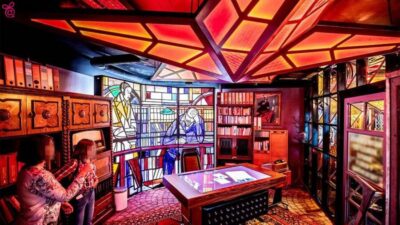
Communist History Tour with House of Terror Option
Read our review →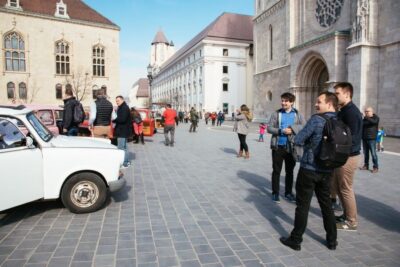
3-Hour Walking Tour About Communism (Small Group)
Read our review →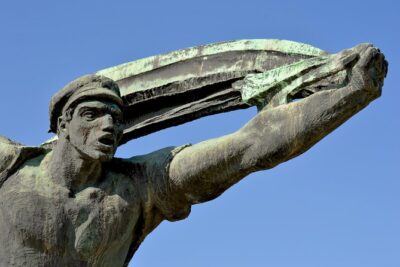
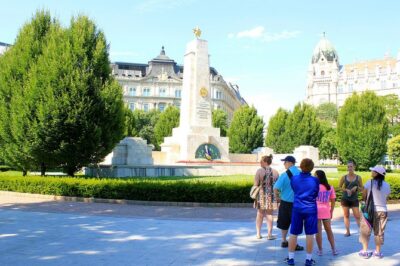

Lives of Hungarians Under Communist and Capitalist system
Read our review →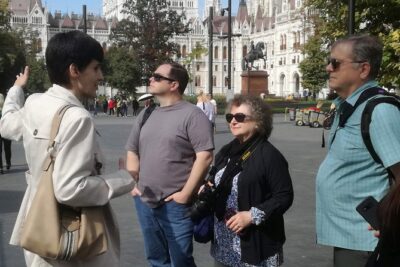
Browse the lists this tour appears in